The Streets are Not the Same II

FAEA983B-7E2F-40A3-87C5-28C2048AF408
Monroe (2006). Oil on Canvas. Artwork and Text copyright Danny Grosso.

There was once a restaurant here that was open for a hundred years, and a cantilevered sign on the corner that predicted the weather. Across the street, the sloping building with the Chagall mosaic on the outlot still attracts those worshiping a certain aesthetic deity. Sometimes people pray there.  A generations-old tale tells of a little girl who called the sloping structure “The Skateboard Building”, after musing about the feasibility of gliding down its curves on those little wheels. Over time, with the discard of several generic corporate re-namings, the nostalgia of the tale took hold, and now everyone uses the little girl’s name for the place. It used to be a big bank with thousands of people working inside, milling about with customers, sipping coffee in the interior promenade, and reading newspapers in the atrium. Such a quaint notion in these times of remoteness.  Banks are still around but they no longer need to employ so many people, certainly not for person to person servicing.

Before buildings became fortresses against outside threats of violence or contagion, they were open, even welcome meeting places with their own personalities and charms. If they were thought of as shelter, it was from the from the elements only, and, indeed, in inclement weather, workers would commute though a series of building lobbies to their destinations, thereby limiting exposure to the wind, rain, cold, or snow. Building security personnel did not carry weapons and did not turn away the uninvited. They were instructed to greet the public with kindness. It is said that nobody thought twice about freedom of movement back then, before the great walling off,  before the eyes in the skies, the surveillance web, and the personal chip that connects to all that. Apparently, they had no such infringements back then to clutter their minds.


-Danny Grosso

Another Political Bestiary, Ep. XXIV

EB9257AC-D684-4CD6-964D-13CDDE8714CD
The Redactor (2019). Acrylic on paper. Artwork and text copyright Danny Grosso.

Continuing the expeditions of Jeff MacNelly, James Kilpatrick, and Eugene McCarthy, with apologies.

The Redactor

Focused, overly cautious, and slathered in black ink, the Redactor is a creature born of conflict that considers itself a peacemaker. The pads at its squared off extremities are highly evolved, with the help of black ink, to the task of obfuscating text. A lot of text. The creature works with important and often sensitive documents, upon instinct and at the behest of its superiors, blocking offending passages in uniform opaque bars of oblivion. It seems to think it is performing a vital service, perhaps producing a more peaceful world by shielding documentary subjects from uncomfortable publication. It does this with relish, and with the dedication of a programmed technocrat, although there is a theory that the creature may be a bit of a free spirited aesthete, as its work sometimes takes on interesting patterns that do not seem to correspond to traditional editorial practice or any logical construct. When overcome by either this artistic euphoria or extreme partisan caution, the Redactor can produce pages and pages of entirely obscured text, which, in an act of crass self promotion, it then offers up as fodder for op-ed columnists and internet memes.


Danny Grosso

Neon Moon, No. 2

4167EF17-9BC8-439E-8D2D-CB455B1DBBAD
American Flag (Neon Mood, No. 2) (2019). Acrylic on paper. Artwork and text copyright Danny Grosso.
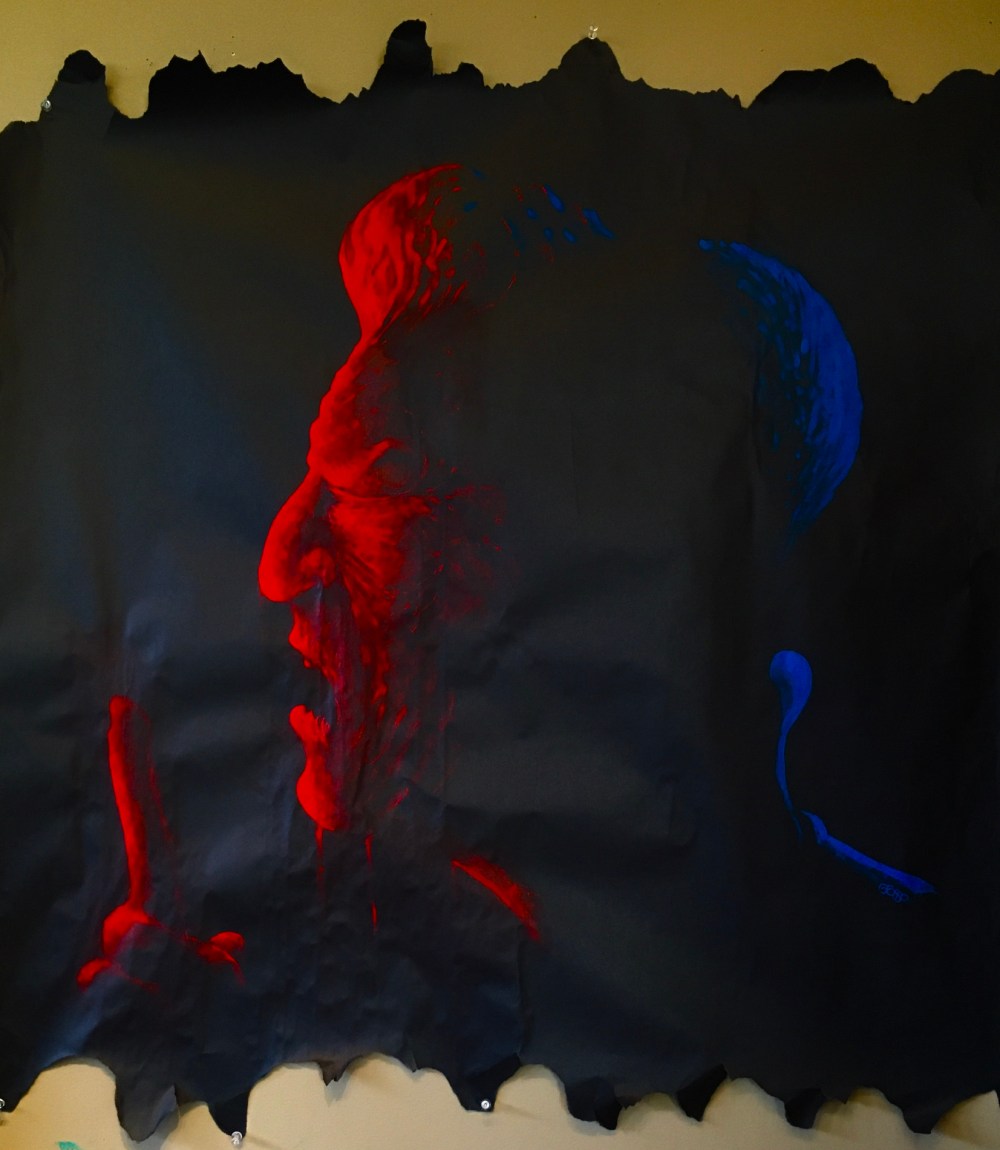
It was nice in here, long ago, when the news wasn’t on all day, when the channels on the tube above the register didn’t require a team sweater. Hard to pinpoint when it all changed, but there surely was a time when the customers made nearly the same amount of money, lived in the same kind of houses, shared the same sense of modesty. They looked out for the other guy, argued and made up, ostracized no one. Sure, over boilermakers they’d gossip, sometimes maliciously, but they’d come back the next day, sit at the bar together, start over. The resiliency of their relationship to the place, and to each other, was borne of hundreds of such instances. Now the only thing that seems unchanged is the wood paneling, the sleigh bells on the door, and the neon sign in the window. Red, then blue, then off for a sec; repeat ad infinitum.

When the real arguing started it seemed mundane, until people started leaving in bitterness, stopped showing up the next day, then the next.  The words had changed, knowing or snide commentary discarded in favor of brutal personal attacks. Instead of another fiver on the bar for the next round, a dollar tip, a look of disgust, and exile. Sometimes there was no interaction, the choice of news network was  compelling enough. Look at the T.V. , shake head, leave at once. “They have the real news on at the diner…” they’d say, and be off.

Nights are the worst now. Agitated by traffic, they come in looking for a fight, and always find it. It is a bunch of vehicles of hate in here then too, charging at each other, spewing the pungent but empty fumes of their fuelers, horns a’honking.

The barkeep had to weed the jukebox – the soon to be ex-regulars would squawk whenever a song came on by those girls from Texas that were ashamed of the second Bush; and heaven help the place if a tune featured a Spanish chorus.  He used to think it easy to find a song that would change the mood, but now he was afraid to feed the juke those dollar bills he’d smooth between his fingers. Everything is provocative when people are fed up, or angry, or confused, or ignorant, or all of the above. At least that’s what they say on the news, or what they used to say. Last week the barkeep unplugged the T.V. and threw it in the dumpster. The eerie blue light of the tube no longer interfered with the neon. Red, then blue, then off for a sec; repeat ad infinitum.


-Danny Grosso

The Streets are Not the Same I

FFE7918F-DABD-4644-B8A1-4B3A6F8CF6E8
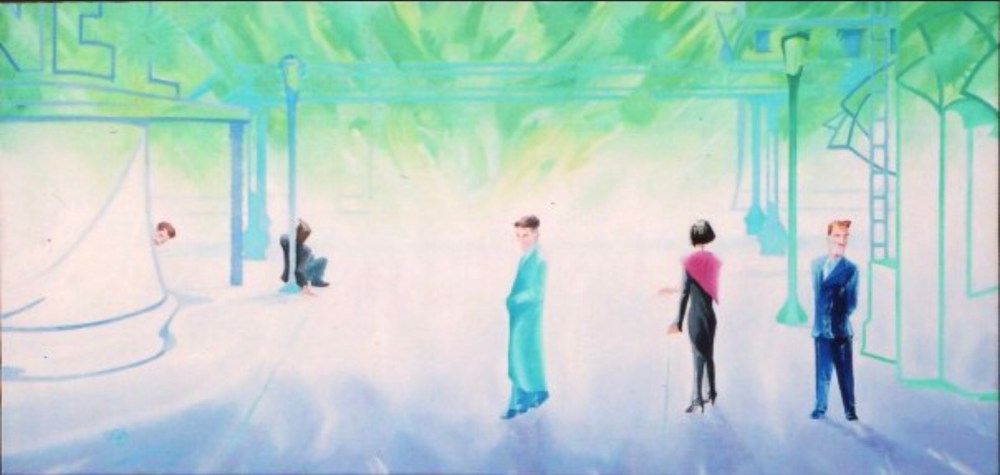
Madison (2006). Oil on Canvas. Artwork and text copyright Danny Grosso

Back then, when people stowed themselves in the Loop all day for work, there was a salon on the corner here where the lawyers used to come for pedicures. They would sit right in the window, and their pants, hiked up to the knee, exposed pale calves that glowed in the refracted light of the sun. Around the corner, under the tracks, the environment was entirely different – ten degrees colder under the shade of the El, dirty, grimy, and malodorous. The homeless sought refuge from the light and heat there, and the alleys collected their detritus. Before the pandemic years, before the government gave them pod homes, they slept out there in the mess. It may seem that a city would wish to disown those times, but rather, it seems to make a concerted effort to retain some of the look of the past, in a sanitized, Disneyland manner. Old light posts and metal beams are refurnished and installed along the street, faux-finished with rusty hue around the rivets. Dignified brass name plates decorate the stone facades, honoring firms once housed within. Their offices are entertainment spaces now, as there is no longer any reason for most workers to labor outside of their homes. The parade once visible several times a day here is diminished to a meandering gathering, without haste mostly, of gawkers. It is clean enough now on Madison to wear your best clothes and saunter about all day, like an Astaire flick from a century and a half ago. Doesn’t even have to be Easter – remember that holiday? Progress.


Danny Grosso

Alley Tags I

Alley 1 (2020). Spray paint on wood, Artwork and text copyright Danny Grosso.
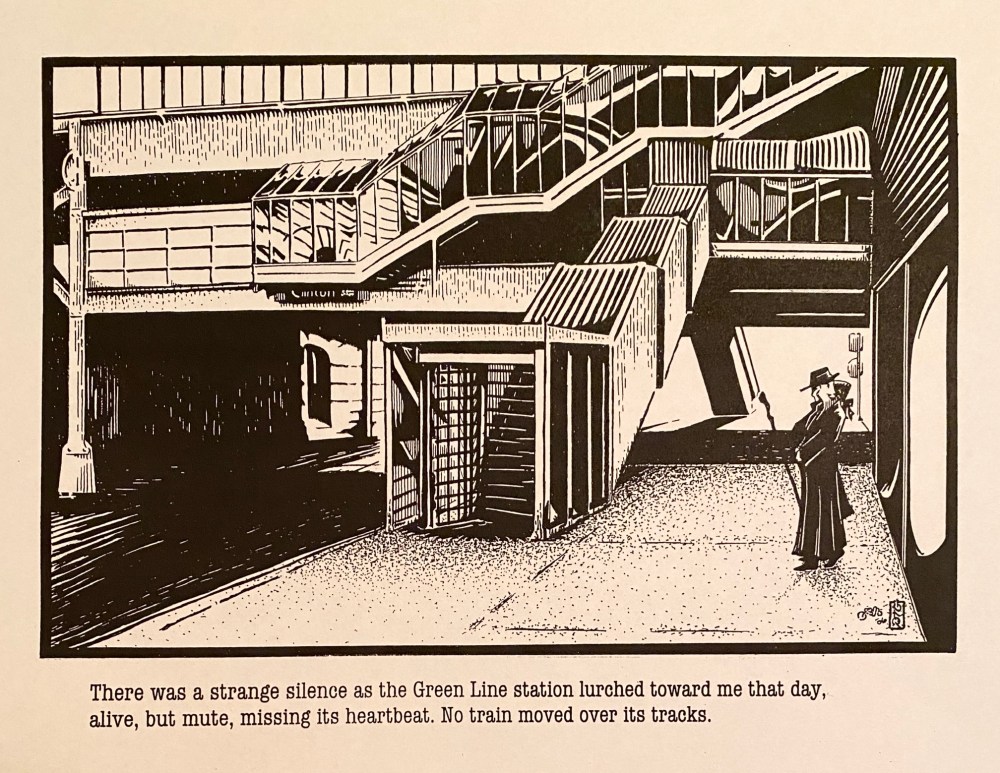
The alley had a curve, which was uncommon for Chicago. The City’s grid of right angles and diagonals had no tolerance for curves between the blocks. On the left side, at the west end, someone had painted part of the  brick alley wall black. Even during the day this anti-artistry exaggerated the shadow in the alley. At night, the blue light bulb above the tavern service entrance produced a two color ghastliness to the goings in in the narrow darkness. The sounds of slurring menace and  breaking bottles devolved into echoes against the curving bricks. The fire escapes above, brushed blue by the tavern bulb, hung silently, intermittently hiding a spectator, or a cop, reviewing the parade of undesirables below.


-Danny Grosso

Another Political Bestiary, Ep. XXIII

D8DE7A6B-8591-49D1-B30C-7930E20A0902
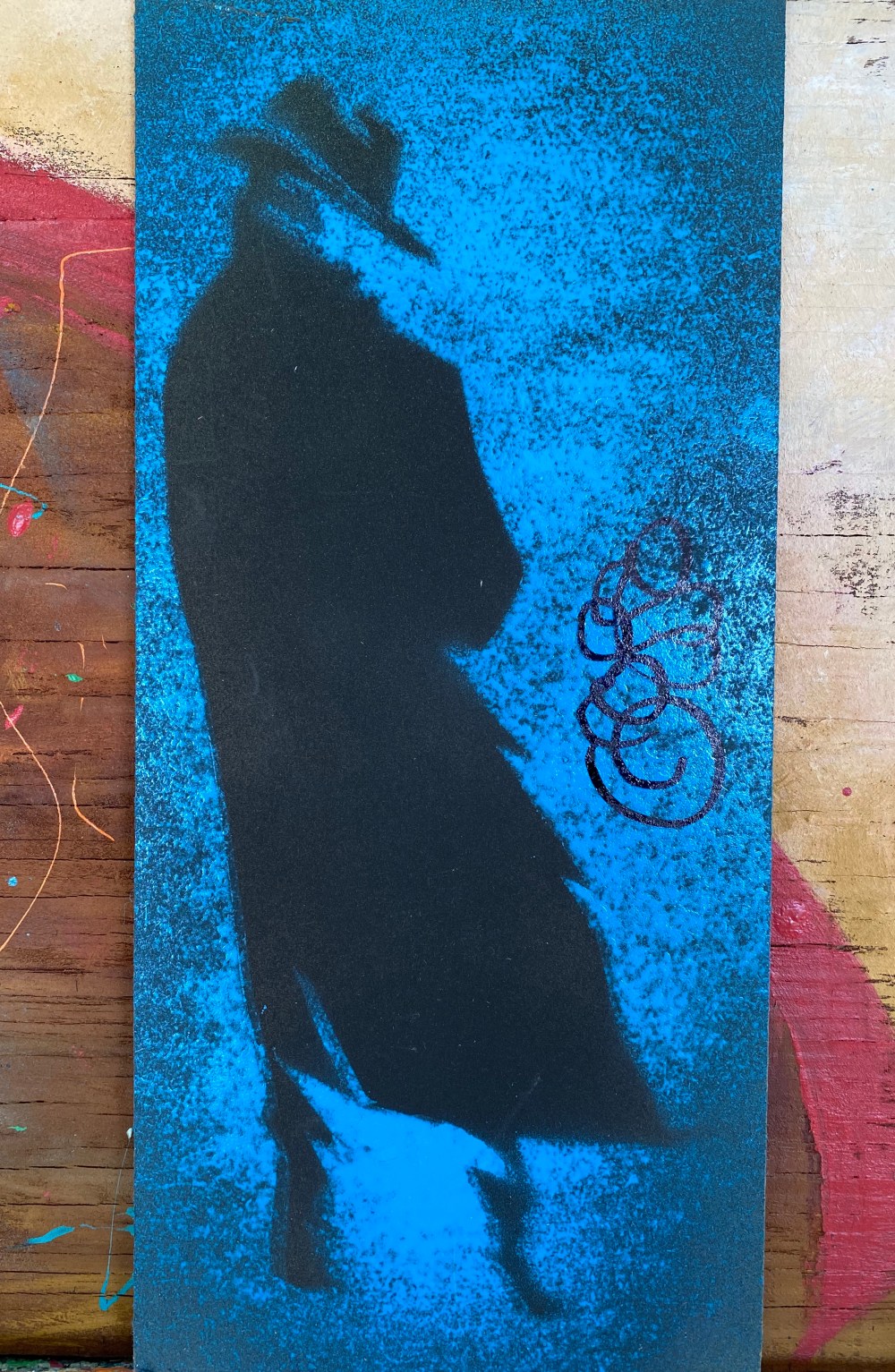
Envoy (2019). Acrylic on paper. Artwork and text copyright Danny Grosso.
Continuing the expeditions of Jeff MacNelly, James Kilpatrick, and Eugene McCarthy, with apologies.

The Special Envoy

Steeped in protocol and realpolitik, the Special Envoy occupies a very specialized niche in the Bestiary. Rumpled and travel weary, the SE is a uniquely nomadic professional pol, barely staying in one place long enough to complete the task of saber-rattling, or peacemaking, or whatever its charge happens to be. Pockets stuffed with language instruction books and odd currencies, the creature can declare “We are nearing a breakthrough!” in almost any language before hailing a cab to the airport. En route to meet its master, the SE is likely to dash off killer communiques to interested parties, including its publicist, while chatting over secure lines with underworld contacts interested in propping up some nascent regime. Its eagerness to fly has made its position secure in the age of Skype, for the SE has always relayed that its results were reliant on face time, not FaceTime. Even when merely in residence at a think tank (in between assignments) or on holiday (summers in Gstaad or on the Baltic Sea), the Special Envoy is always on the grid, racking up contacts and frequent flyer miles in spades. The creature is truly international, though rarely seen in the U.S., save for brief roosts at Camp David, or, in intemperate times, CIA headquarters in Langley.


-Danny Grosso