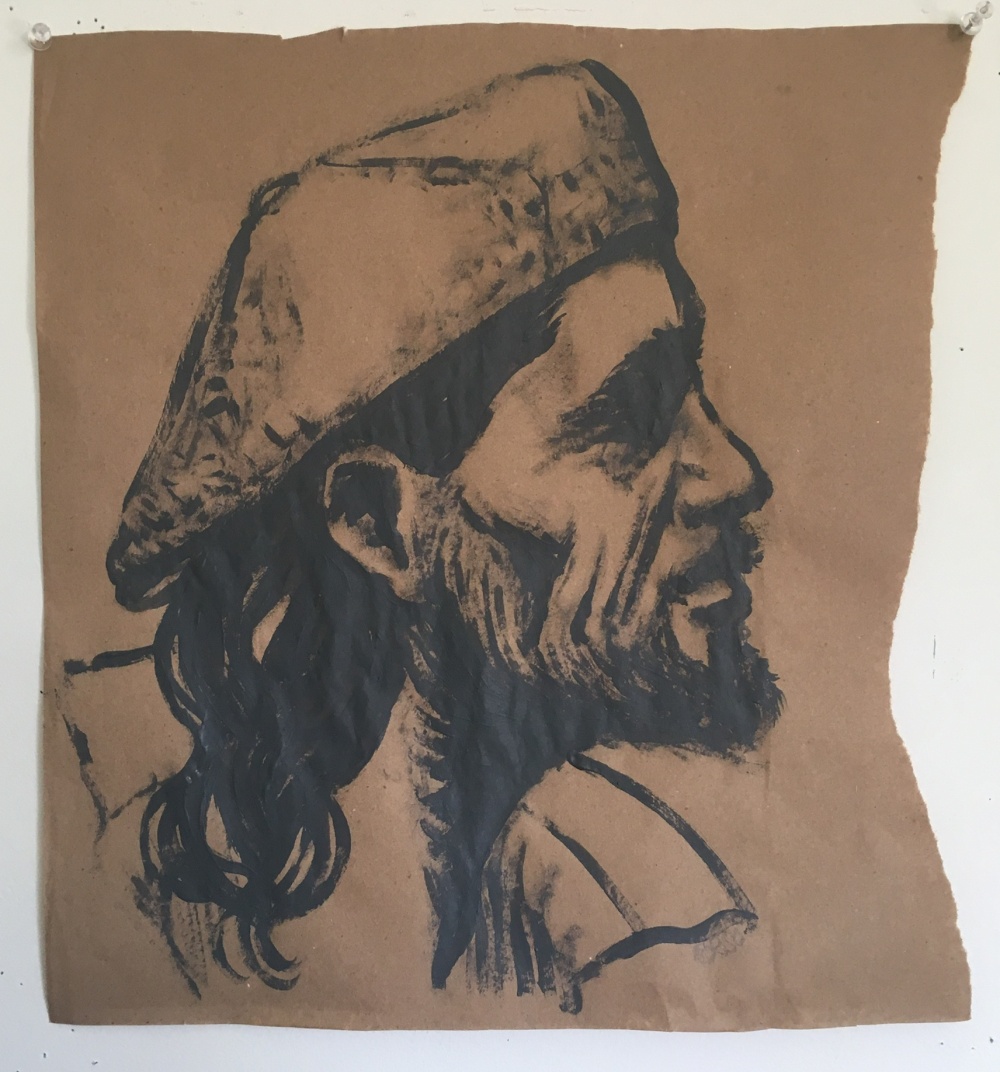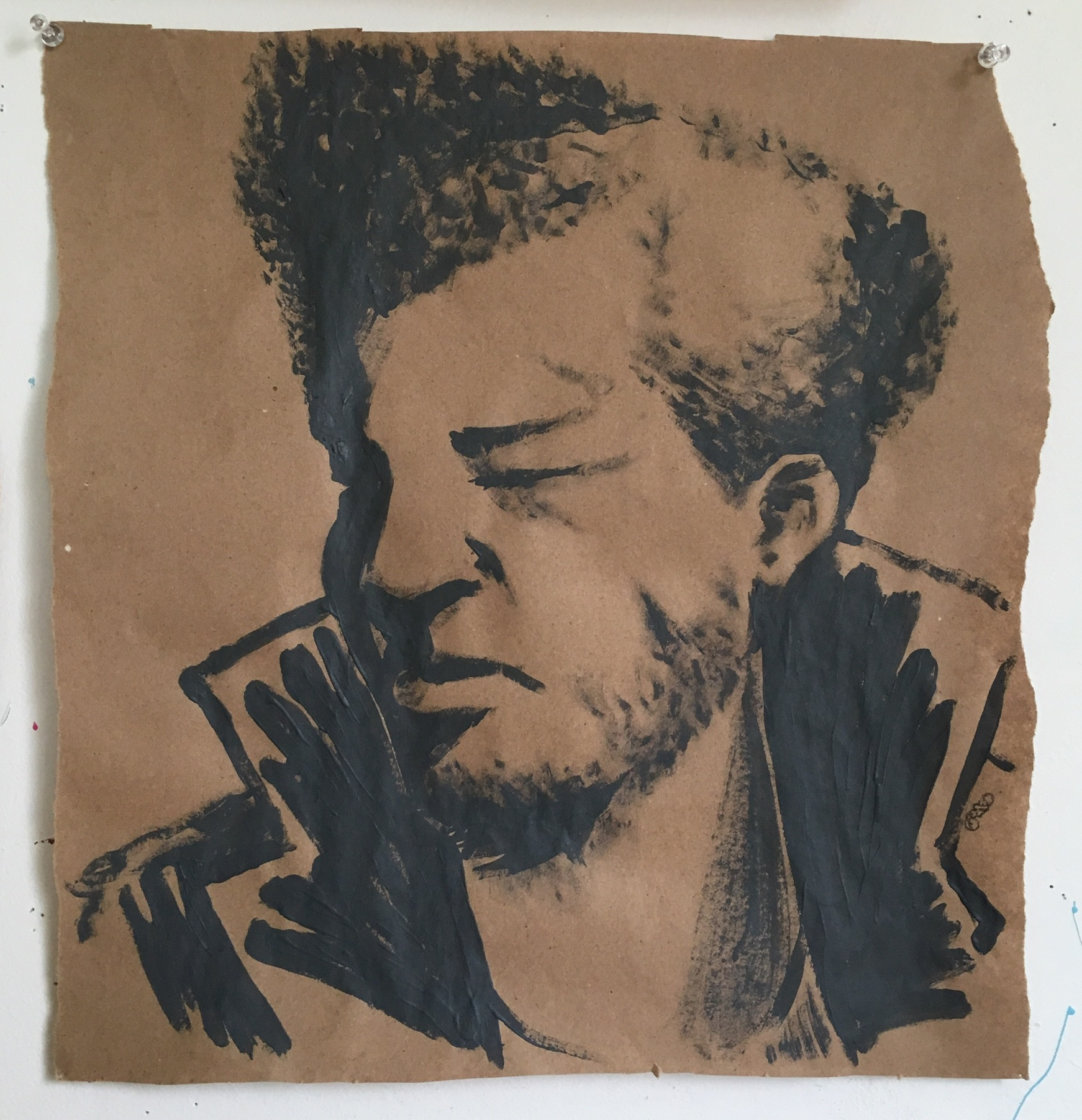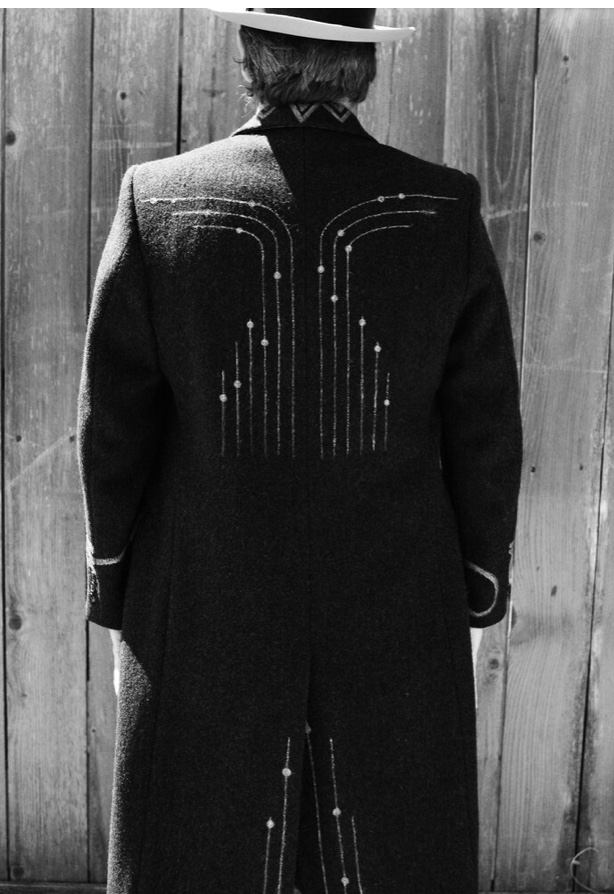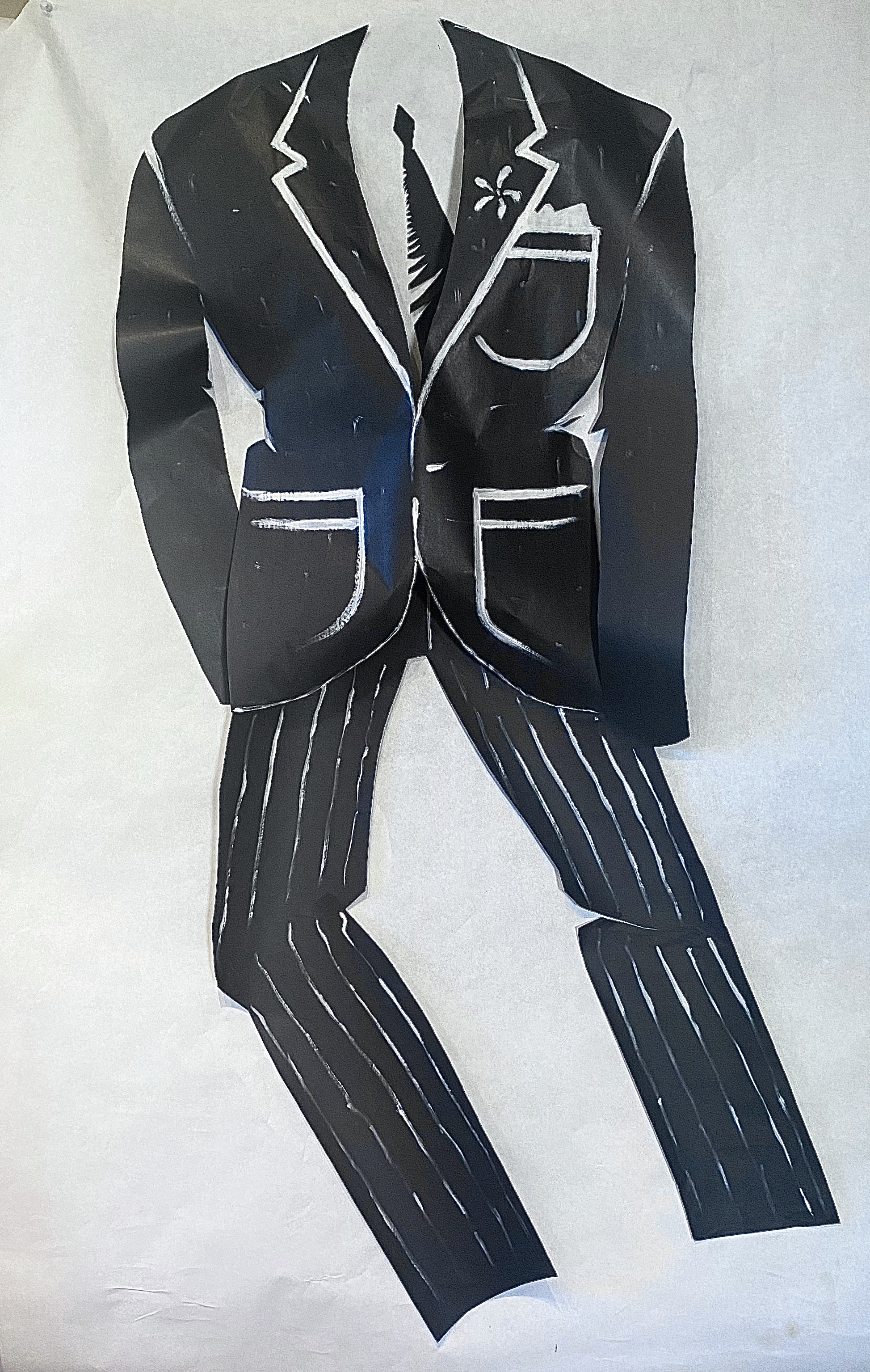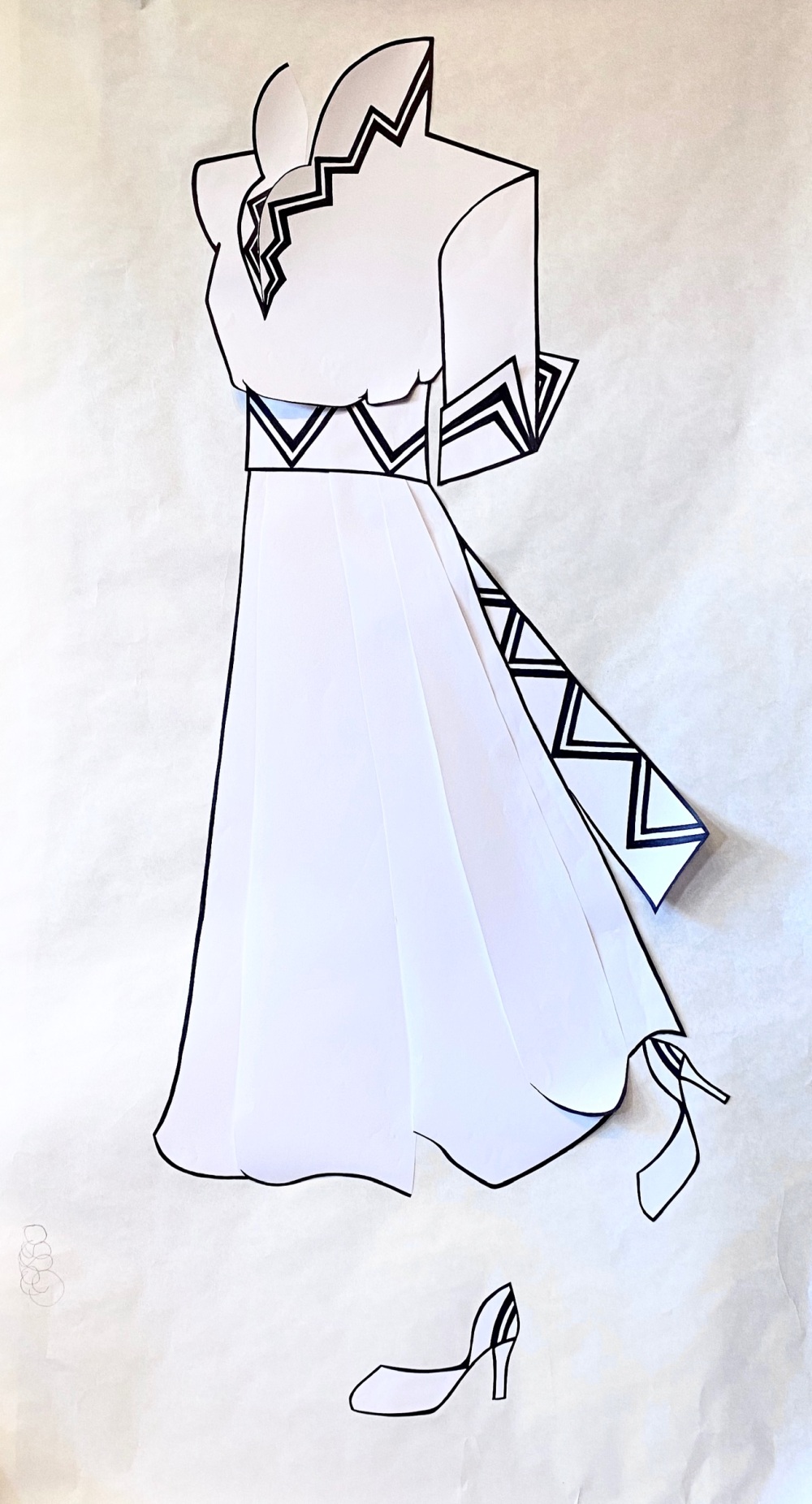
Christmas Eve (1980-?). Acrylic on cardboard. Artwork and text copyright Danny Grosso.
Back then, when the tree sellers closed their businesses for the season on Christmas Eve, they would abandon their unsold inventory on the otherwise vacant lots. The hawkers of balsam and fir had no use for their wares after December 24, so the trees stood alone in the dark, like pilgrims queuing up for a shrine. In our neighborhood, late at night on that twinkling holiday, a liberator would appear, dancing through the snowy and quieted lots. The legend has it that he would take the forsaken tannenbaums, throw them into the back of his drop-top sled, and deliver them to shut-ins, leaving the evergreens on front porches for Christmas morning discoveries. The recipients were easily chosen, for in that era, most neighbors commiserated with one another, and one might easily determine which of them were unable, due to illness, poverty, or other misfortune, to venture out and deck the halls.
This was much spoken about for some time, and the mystery surrounding the identity of the benevolent phantom was never convincingly solved. Over time, as often happens, people turned to speculating about other, newly discovered intrigues, and interest in the phantom waned. Yet, even now, we are greeted each winter, in one or two pieces of holiday correspondence from the old neighborhood, with news of Christmas trees being left anonymously on porches.
All legends die hard, especially those grounded in the time of willing hearts and kind intentions.
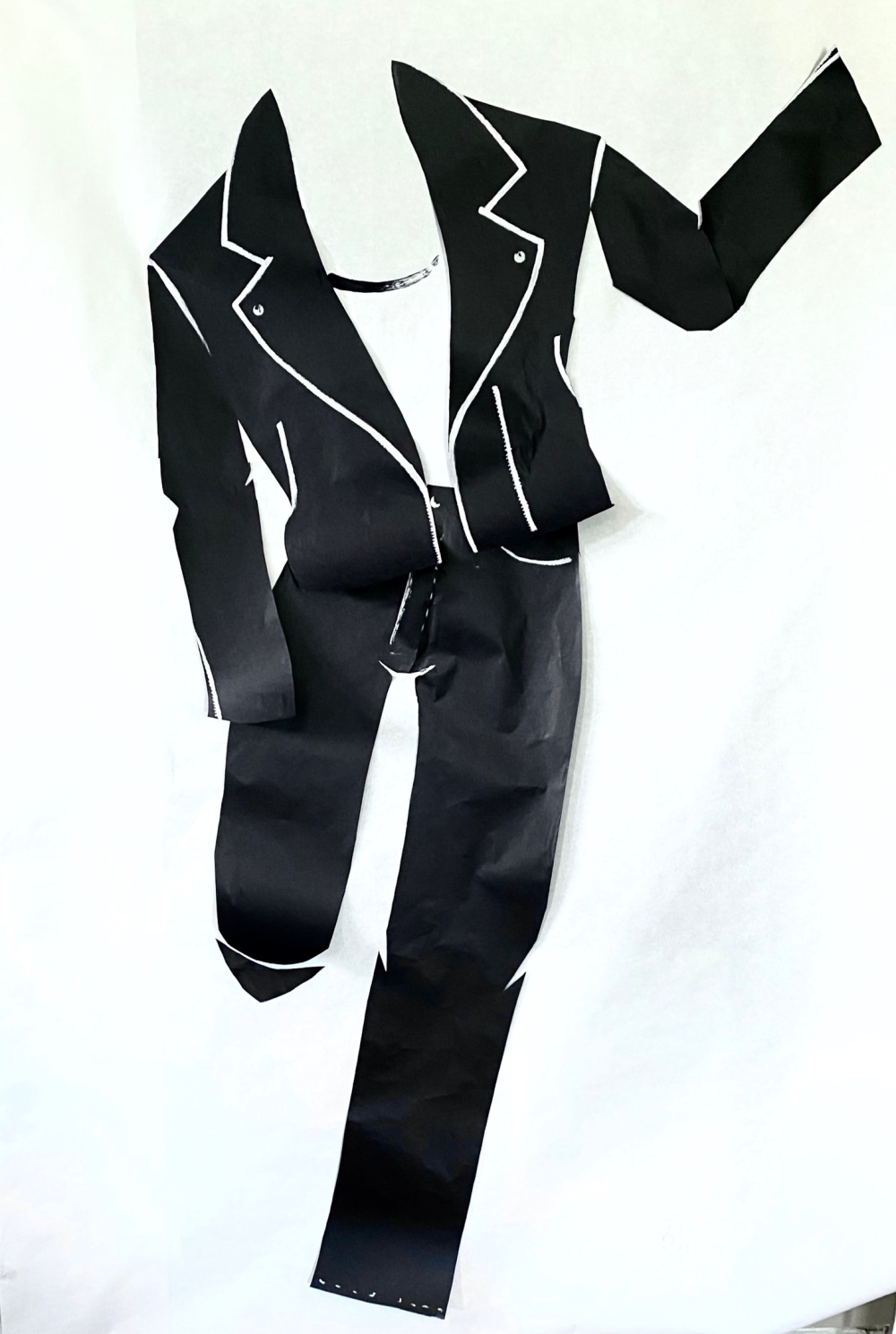
Barefoot (2020). Acrylic on cut paper. From the book Barefoot and Other Stories. Available at Amazon Books. Artwork and text copyright Danny Grosso.
When the tailor came out for the first fitting, the customer was sometimes barefoot. In summertime, as the 70’s fell out into the 80’s. men would wear light-colored loafers, without socks, as they went about on Saturdays. If they stopped into a clothier on a whim, and were cajoled into a purchase, they’d sometimes emerge from the fitting room barefoot, as if tailoring a trouser leg was too formal an event for loafers. Barefoot, however; somehow more appropriate.
The tailor, responding to a salesman’s buzzer signal discretely triggered from behind a mirror, would stride out as if to martial music, and slow the march upon the sight of toes wiggling under the un-hemmed pant legs. With a grunt, he’d point to the offending nakedness, and the salesman would be compelled to inquire of the gentleman as to what kind of heel he might be wearing with the ensemble. Now, the 70’s had passed and taken platform shoes with them. So, the tailor could, in expert approximation of median heel height, tailor a pair of paints for a barefoot customer. However, this entire vignette was yet another unspoken signal to the salesman to skip over to the shoe department and bring a pair back that might ease the tailoring process and wrap up another sale.
Salesmen quickly learned to approximate a customer’s suit size upon first sight. Shoe size, though? Much more difficult. Further complicating matters, one couldn’t propose the purchase of an ill-fitting, pinching shoe. Nor would one wish to keep a busy tailor waiting as a customer tried to wedge his foot into a too-small monk. The result was that all of the size 11 and 12 shoes were stacked on top of the piled shoebox displays for easy gathering. The customer could slide right in, and if the salesman chose right, and the customer liked the way the shoe looked with the suit, he could fit the pair after the tailor had left the sales floor. If this little bit of theater resulted in extra commission for the salesman, the tailor would get his lunch for free that day.
One might surmise that all of this salescraft and subterfuge soured everyone to the whole enterprise of visiting the haberdasher, but for all that was shadowplay, there was a real elegance to the ritual. Some regulars were rich dandies but many of the customers visited rarely, only in special times of celebration or need. A wedding suit or tux, or maybe one to wear to a son’s graduation – something very nice because he’s the first in the family to go to college. Standing in that grand three-way mirror for a fitting prefigured the pomp and circumstance of matrimony or commencement, and added an extra day of harmless indulgence to the event. The sales staff kept a bottle of single malt and shot glasses in the stockroom to share with customers like these.
Of course, the most dignified presentation was reserved for the mourning. The store would hush as word went about. “Funeral suits” one would say to a colleague, nodding toward the aggrieved. The respect afforded to these poor souls was edifying. Salesman who spoke out of the corners of the mouths to neighborhood hoodlums stopped dropping the endings of words. They stood upright, addressed the family as “Sir” and “Madam”, and guaranteed the garments would be fitted and delivered for them to wear in time for them to receive the line at the visitation. Tailors would pay their verbal respects in broken English and then stay late if the alterations for these customers were complex. The staff, arriving early the next morning, would sometimes place notes of condolence in the pockets of the finished garments.
There were times when a mourner, retrieving his mourning garment, confessed that he knew not how to tie a cravat. A stockboy would ask for the tie, discreetly slide into the stockroom, and emerge with it knotted and dimpled; ready for a simple donning.
“Thank you.” the relieved mourner would say, quietly.
These small, elegant moments are mostly gone now, perished with the advent of the digital economy, the casual Friday, and the triumph of the big box store.
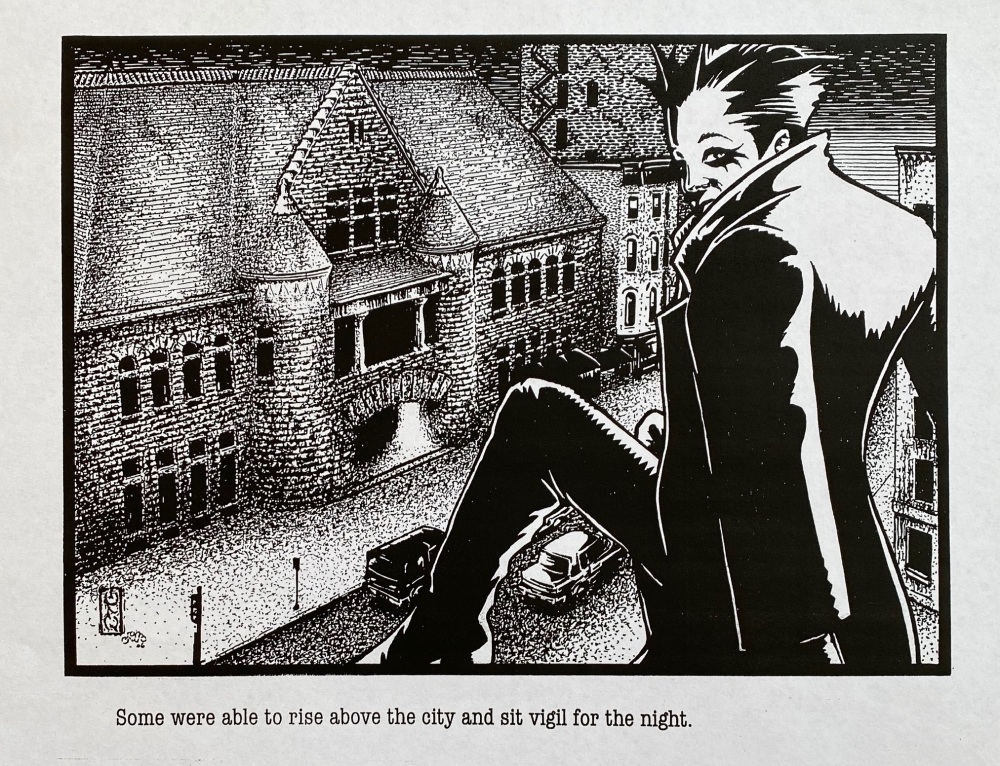
Lash (2022). Acrylic on paint can residue. Artwork and text copyright Danny Grosso.
He didn’t say ‘Boo” because he didn’t need to. Central Casting could have provided no better spook. That face, the spiked beard, the arching crown of blue-black hair, a mane really, tamed momentarily be the oil, and, like him, ready to bust out into mayhem without notice. He had a voice that, before cranially implanted messaging receivers, would have been used on radio to portray monsters. Surely he knew all of this – he did nothing to change his look or his vibe. Perhaps there was nothing he could do – he seemed born into this character. He inhabited himself so thoroughly. His fly-car was painted disappearing black and when he landed and oozed out of the pit with his long coat it was all like the oozing of ink in the ocean. Then he’d disappear into the night streets.
Once, long ago, there was a story of a child born into odd circumstances, whose visage so frightened people that the child, grown accustomed to menacing peoples’ sensibilities, accepted his abilities and embraced his destiny as a spine-tingler. He was, certainly, an odd child, and an extraordinary adult, in the way that a feral cat will be odd and extraordinarily different than a house pet. Our man would lurk in doorways and under bridges, where all one could see was the whites of his eyes, if he’d allow it. Weather seemed not to bother him. He’d be the only one out in the rain. Dogs on leashes would injure the arms of their walkers as they bolted for the opposite side of the street. People seeming to be in his circle would disappear without a trace. Authorities, knew of him, of course, but even with chip-enhanced surveillance and anticipatory interventions, no pattern was ever established to lead to his removal. Not that it would matter – his horrific gifts were such a part of him that any colony that received him would have established a similar oral legend of fear in no time. One other thing; he seemed to be impervious to time. people spoke of their grandparents fearing him when they were children, when he was, well, the same grown man, in the same clothes, haunting the same places – everblack with a red red aura.
On Halloween one year, ages ago, some kids saw him crouched atop a streetlight post. Grounded beneath him, a small flock of dark birds stared up at him in rapt attention, as if wondering how he had displaced them. They seemed clearly fearful of reciprocating. It was said that on the following morning, All Saints Day dawned without a single chirp, caw, or call, and that there were no birds at all in town that winter. Belief spread, and the legend was born, that the birds had been dispatched into the netherworld by the awful power of his evil stare. The memory of those events has faded, yet still abides. The old of that place still walk out at midnight each November 1st, spreading feed under streetlights in hopes of averting the birds’ gaze from their lamppost tormentor. In remembrance of the birds lost that long ago overnight, the elderly seed spreaders have taken to pinning black feathers to their outer garments as they attend to their nocturnal duties.
192 Spy Trap (2023) Oil and Acrylic on board. Artwork and text copyright Danny Grosso
Secret agents gotta eat too, so I popped into this joint on a breezy street just off the Mag Mile. The guys frequenting the place were done up just like me – they were secret agents of another kind, for different kinds of chiefs. So, being from separate tribes and all, they looked at me with cowboy eyes, and bared their teeth, which were strewn with garlands of rapini. I ordered a sidecar at the bar, and another, and by then everyone’s nerves seemed calmed enough for me to have lunch and sit on a stool. The place still had hooks hidden under the bar to hang hats. so I put mine there and ordered a Delmonico, rare.
Halfway through the steak, which was great, a twist walked in, half wrapped in a fur shawl. She stopped at a table for a whisper, then moved to the opposite end of the bar, resting just a bit of herself on a stool. Things stayed this way for a minute, and I was going to send a drink, but the bartender suddenly walked over to her, and after a short conversation, she got up and walked out the door. I took a bit to chew and headed for the restroom, wondering if this little vignette was something I needed to sort out. So I ran the water and pretended to wash my hands, and unable to decipher a scheme, I headed back into the dining room.
Everyone was gone, excepting the bartender, who appeared to be rooting around for something under the sink. Every table was empty and set, servers and bussers were out of sight. I spun my head around slowly, as I’d been trained to do, but saw nothing but an empty restaurant. The barman popped up, and asked if he could help me. His accent had changed from southside Chicago to cockney. He even called me mate. I could see that my place at the bar had been cleared. I nodded towards him, “You getting the place ready for a private party?”
“The whole of our world is a private party, innit?” he replied.
Free lunch or not, I wanted not to be there now or ever again, so I headed to the door, which was only there in theory, as it looked like a door but did not function as one. It was clearly part of the wall of glass and wood framing that fronted the place, and also not separated from it as an opening. Still, I pushed at what did not give. I could see outside now, and the street was barren, windswept, lots of East Berlin before the fall vibes. And then the light changed, accelerating shadows, daylight to dusk to sunrise again in a matter of seconds, cycle repeating, dizzying. I blinked, involuntarily, then hoped it would reset the scene. I turned around. The bartender was smiling at me, and around him were my family, as they were when I was a kid, the old grandparents, uncles and aunts included, dressed up for a party and bearing gifts as if it were Christmas. “You can join the party or not,” the tender said, “it is always your choice, always was.”
What ever else would I have to do in place of an old-time family Christmas? I disregarded all of my training, I subjugated all of my skills. In that instant, I knew that they were all useless against whatever power had produced this moment.
As I walked over to them, one of my aunts began singing a Christmas carol.
Dance with Me, No. 1 (2003). Oil on canvas. Artwork and text copyright Danny Grosso.
That move, where she turned away in sync with the key change and a stole furtive glance back, it got me every time. The haze from the smoke machines masked the neon dance floor in pastoral veil, and for a while it seemed we were in an English romantic novel – her white blouse a beacon in the countryside entreating her darkly clad lover. Just as such words on a page would be, the mind’s image of this is eternal, and even if the meaning of the moment may diminish with time, the intensity of the memory may still burn.
She would turn back to me, and away again, following the prompts of the music, the momentum of her body, and the instinct of her mind and soul, and I would do the same. Perhaps that is why we returned over and over, to the same place to the same music, to the same dance. Perhaps it was a way, maybe the only way back then, to feel completely, and safely, in sync with and within someone else.
Sci-fi Special (2021). Acrylic on board. Artwork and text copyright Danny Grosso.
Into the vortex they ran, in to an extra-dimensional world where they all wore long tweeds, like it was a 50’s episode of a sci-fi serial. They ran willingly, purposefully, like reporters to a schoolhouse fire; or maybe not ran – can they run here where there seems to be no ground? It looks almost like the floor of a meadow, but it is kinetic, moving clockwise, here, reversing there, ebbing and flowing here and away. It is so strange in here, but then there are familiarities in the beings that suddenly appear, and themselves: the cut of the hair, the harried looks, like hoods on the run. familiar sights indeed, every noir story has them, but what of this setting, what of the vortex?
Perhaps they are to continue in this struggle. Continue to run to assist others, to explore the frightful unknown, to set worry aside and go…go.
As they made the second turn an untraceable sound descended on them, high pitched but full, and a light shot through the space they inhabited. They felt that light surge through their bodies. Then all was black for a moment or maybe a hundred years, and then when they once again became aware, they were floating in a celestial wonderland, until they turned their heads and they were in a 1970’s den, sinking their toes in shag carpet. Elton was on the stereo system. Levon sells cartoon balloons in town. Turning away, they are bathed in the galaxies. turning back, Levon likes his money…
The Hardie Boy and Alec (2010). Ink on Board. Artwork and text copyright Danny Grosso.
They’ve both been gone 30 years now, and the store’s been gone 20. When we worked there we represented three different generations, and presented three radically different stories. The Old Bagel was born in Manchester, the one in England, at the turn of the last century. He was well educated there, but he immigrated to Chicago after the great war to work in one of the great, old, clothing houses. The Hardie Boy was a street kid from a dirty neighborhood who didn’t like school much, so he joined up with the army and served on a Mekong gunboat. He was working at the store because he could, in sales, just as he might be selling cars, or carpets. Not much of a vocation, just a job. I was the kid. I swept up, ran the errands, and learned through their stories about the world that once was.
The Old Bagel had invented a shipping box that his best friend co-opted and used to make a fortune. None of this bothered the inventor – he slept like a baby at night, and napped daily in a corner chair behind the size 42 Regular suits. The Hardie Boy was an insomniac, unable to sleep ever since his gunboat was boarded in the black of night. The desperate shooting; he grabbed the deck-mounted machine gun and started blasting into the darkness, may or may not have left some dead sinking into that river.
One was laconic, the other was caffeinated; one was erudite, the other was colloquial. They managed to laugh a lot, and make us laugh with them. Through their idiosyncratic banter they became such a part of the place that I always imagined them hanging around even in death, waiting for me to bring back lunch from the Greek, or beer from the liquor store at closing time. The Old Bagel lived to a ripe old age, but the Hardie Boy died young, of his own demons, in a shrunken space not unlike that gunboat. The space between their deaths was likewise brutally close, but it allowed us to mourn them together, as forever linked, in a way that two souls so different might never be. Even now, it is hard to think of one without the other, and then of the rest of us, making sport of each other, laughing, and finding our way together through a busy Saturday afternoon at Christmastime.
Sand and Sea (2018). Acrylic on wood. Artwork and text copyright Danny Grosso.
Sand and sea, the colors of life, of everything. The sand is the product of the life in the sea, and the sea finds its rest in the billows and hollows of the sand. Their colors compliment each other like beloved friends at a ceremonial toast. They are the best set. The tan suit in the closet seems to spring to life when paired with that variegated blue shirt. Let’s place this blue rug under this tan sofa and see if it reminds you of something. Yes, it’s the beach, and the holiday, but also something more vestigial; it’s the place we all come from, where everything comes from.
That tension on the waterline, that connection of blue to white, is the crucible we all crawled out of.
There is a certain feeling these colors create together that they fail to create alone. Perhaps they gratuitously provide that lesson to us, about ourselves and our bonds with each other, a lesson that transcends their aesthetic splendor. Or, perhaps not – transcendence may not be for everyone, so let the resplendent visual joy be enough for those that seek only beauty. Like those transcendent souls, the sand and sea await them too..
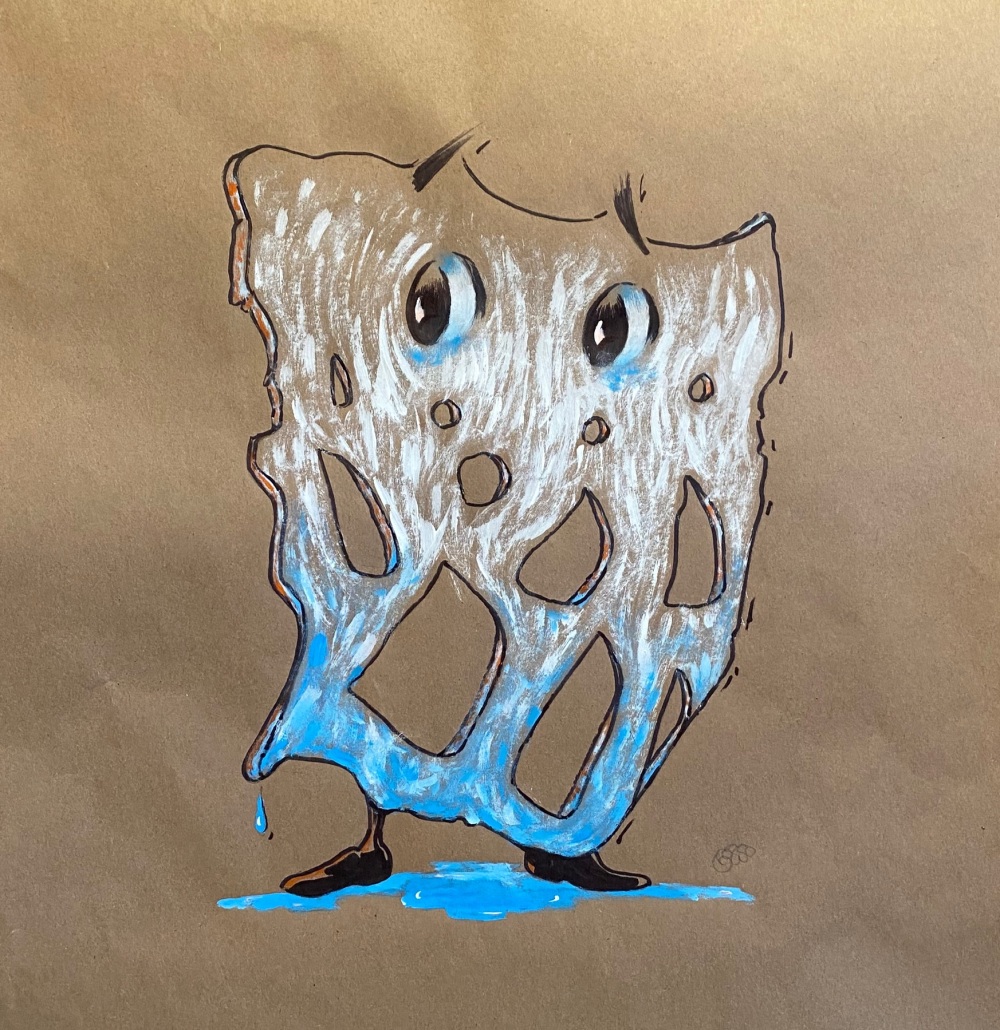
The Confirmation Bias (2020). Acrylic and ink on paper. Artwork and text copyright Danny Grosso.
Continuing the expeditions of Jeff MacNelly, James Kilpatrick, and Eugene McCarthy, with apologies.
The Confirmation Bias
A short creature with a short right leg, this bottom heavy being is always veering off in the direction of its defect. Nearly blind and unresponsive to anything but familiar sensory attractions, it lives an unenlightened existence, ambling in spirals of self affirmation and conspiracy theory. Its acceptance of ignorance borders on gluttony, and it drinks of the empty rhetoric until it is permanently inebriated, pickled even. In this way the wretched creature whittles away its days, until it suffers the mortal wound, inevitably at the hands of its vestigial enemy, the Empirical Analysis, and falls, murmuring outdated dogma, in front of a television blaring an advert for stair lifts.