The pictures continue to tell their stories. July 10, 2025. Bar Sotto at the Italian Village, 71 West Monroe.

The pictures continue to tell their stories. July 10, 2025. Bar Sotto at the Italian Village, 71 West Monroe.

Excerpt: The wind had picked up some dust and pushed it into the street. Cities were a lot closer to wide open lands back then, and one could look down the grid and perceive the emptiness at its end. The sudden gust had nearly knocked her cap off its tilt, so as she half walked, half wandered across, she delicately held it onto her head. Then it was gone – the wind, that is, along with that other thing. Oh God.
During those times, a carpet bag full of pennies could mean a month’s worth of groceries. And she’d lost it. The bag, and all those pennies – taken in by a gutter scammer.
The boy seemed to be really hurt, twisted as he was along the curb. She’d only bent down for a moment to try to soothe him, when she realized the bag she’d placed beside her was gone, and now the boy was gone as well, running into an alley, no longer hurt.
She’d been the penny peddler for almost a year now, selling all kinds of thigs for the copper coin, a flower, a piece of verse, a knitted tea cozy. Sometimes she would be engaged to read to an elderly shut in, or for help with an errand. Often she would work door to door, showing her basket of items, and if no interest was elicited, she’d quickly and humbly inquire if there was any chore she might assist with for a penny. She had some regulars but no contracts, some aspirations but no plans. And now she had no money.
The amount of pennies she had accumulated would have represented an almost vulgar amount of riches had pennies been worth more than, well, pennies. She’d reached both hands into the bag many times to gather to coins, and feel the weight of them. She reveled at the feeling of running them through her fingers. She loved the sound of them hitting each other as they landed back into their nest. She adored the saturated copper color of them, all together cradled by the textured sides of the bag. That bag.
The bag was the last thing she had of her mother’s, and as the time slowly passed on the walk home to fetch her basket of saleables, she realized that the crime had been a double theft. Her mother had died a painful death, she was told, for she had been kept away from the rented room they lived in for much of the horrible end. She was taken in by an unmarried Aunt, who died some years later, during a tragic stillbirth. Such were the travails of being a woman in that age. The bag, supposedly once a gift from an old suitor, first filled with her playthings, and them repurposed as a bank bag, had soldiered on with her. Now she was alone, without the last remnant of her past to anchor her to a place, a time, a family.
They say that crimes like this often have unintended consequences and that thefts often provide the victim, with circumstances that are impossible to fathom, with great riches over the fullness of time. Our girl could not think of such things, alone there, sleepwalking on the sidewalk. She was bereft and lightheaded, devastated by the losses of the day. But she would get her basket and she would hit the streets for the evening passers by. It was payday, that’s why she was out with the bag so early in the afternoon, on her way to the bank to exchange the coins for bills before the rush. She spied a few perfect daisies just next to her in a prairie lot. She plucked them from their bed to add to her basket.
-Danny Grosso

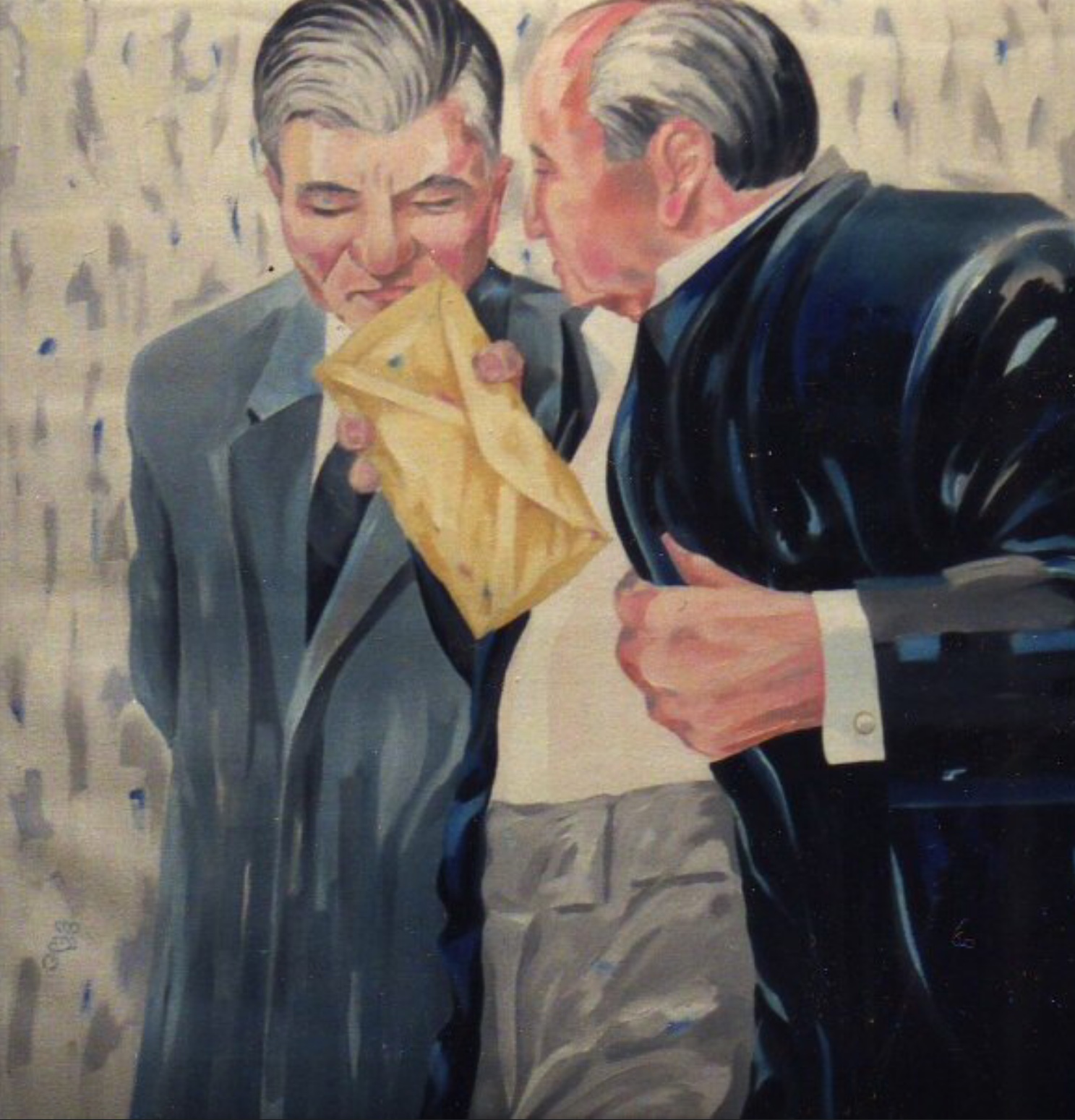
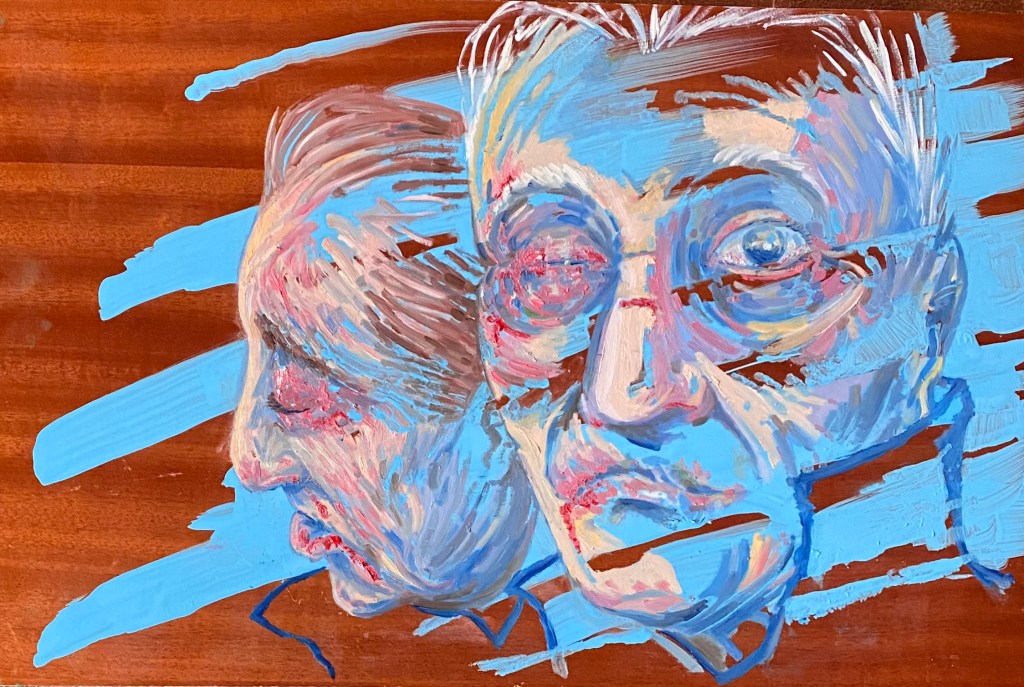
The Wounds of Friendship (2023). Oil on Wood. From my book Trouble is Trouble, available at Amazon Books. Artwork and text copyright Danny Grosso.
Excerpt: “Like him?” he would start, “Why I like him so much it hurts.” He meant it of course, all of it, the “like” part and the “hurts” part. He grew up in a place where you give up your friends dearly, only as a last resort. Lives depended on friendships, on discretion, on fealty, and for that reason these bonds were cultivated from an early age. The older guys would introduce their sons and nephews to the other guys’ kids, so that by adolescence, everyone was spun together in a web of relationships that perpetuated the status quo. That web would tense with outside pressures from money and wives and and really anything from outside of the group, and sometimes strands would break with violence, leaving suspicion as a remainder. Eventually, the web of friendships would become one of betrayal and deceit that seemed inescapable.
Still, most soldiered on, as most did not know any better, they had few relations outside of the group. With age came wizened faces, and to those who knew how to look, the battle scars of friendship. “In this life, it’s not easy to stay friends. Everybody has to watch out for his own.” He would say that even while he was sitting next to Corky or Slugs, whom he’d know since the second grade. As children, they’d inflicted little tragedies upon each other. As adults, dangerous betrayals. Yet for a lot of them, the ties remained, and were often cultivated anew, after the detritus of the past was swept into a lump under a rug – still obvious, but also, important evidence that effort was made, like a memorial to fallen soldiers.
It was hard for some not to see their wounds as grotesque, their stubborn friendships as masochistic and ridiculous. “I know we are so different, and we don’t see eye to eye anymore but there’s somethin’ I still like about him,” he would say. And even through a blackening, closed eye and bloodied lip he seemed genuine in his feelings.
–Danny Grosso

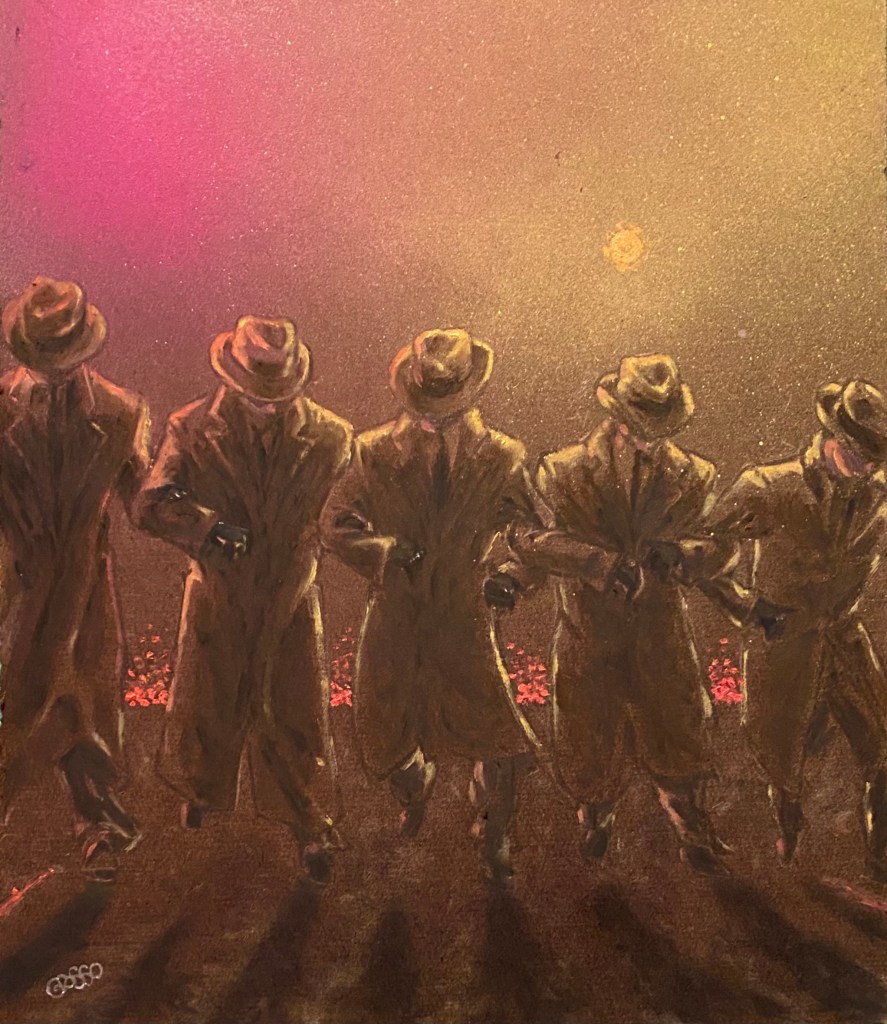
Excerpt: When they lit the oil drums on fire it wasn’t so much to provide warmth. Rather, the psychological barrier between those coldly defending their bosses for pay, and those on the line for the cause, was made physical. Indeed, the physicality of the struggle was one of its selling points. It was deep in the race back then to lock arms with your side, and then lock horns with the other. It was how they recruited us back then. There was no internet trolling, there were no overseas bots. There seemed to be a sort of honor in this dangerous endeavor. Getting in close made the conflicts so much more vital, and perhaps, less frequent. They certainly seemed less petty. In the lines they fought for food, for jobs, for a shot at being a boss someday. And while adventurers bounded in on both sides, most on the side of the cause were true believers, although those beliefs fell just short of fanaticism.
However, when those fires were aglow, and the sparks jumped out of the drums like popping corn, the murmuring seemed to take on an ecclesiastical rhythm, and as it grew to surround the asphalt lot, a certain reverence captured the proceedings. Through the chain link fence, across the open lot between the workers’ cottages, and down the street a bit, a priest is moved by the sound, and opens the window of his second floor room. He too can see the pink firelights, and he too, can ascertain what they portend. He grabs his heavy crucifix necklace and a leather coat and runs toward the music.
–Danny Grosso

Available at Amazon Books. Nine short stories, each derived from and including one of my paintings or drawings. Very streetwise, very twentieth century, very noir. Visit my author’s page at Amazon.com/author/dannygrosso

From Chicago Gothic (2007), Available at Amazon Books. Artwork and text copyright Danny Grosso.

Continuing the expeditions of Jeff MacNelly, James Kilpatrick, and Eugene McCarthy, with apologies.
The Spinner
This spindle-shaped creature has adapted its mind and body to achieve maximum efficiency in sycophancy. Its tapered footing allows for the speedy spinning needed for policy changes. Its large head and 360 degree vision allow it to spot from afar new trends for which to forsake its former beliefs. Another adaptation: hidden in its underside is a gauge to anticipate the prevailing wind, and a gland attached to it to measure the selfish value of the gale. The Spinner’s design lets it orbit a bigger star like a planet, or rather orbit a planet like a dead rock, endlessly circling in admiration and attachment until the bigger body implodes from rot, leaving the Spinner discharged and on the hunt for another object of attraction. Sometimes known by other names, such as Lindsey, look for the Spinner in legislative districts where the poll numbers of a candidate for the highest office are better than those running on the undercard. The creature is also found haunting the executive branch, working short days and employing its knack for ridiculously shallow unsolicited praise to keep its cushy position.
– Danny Grosso

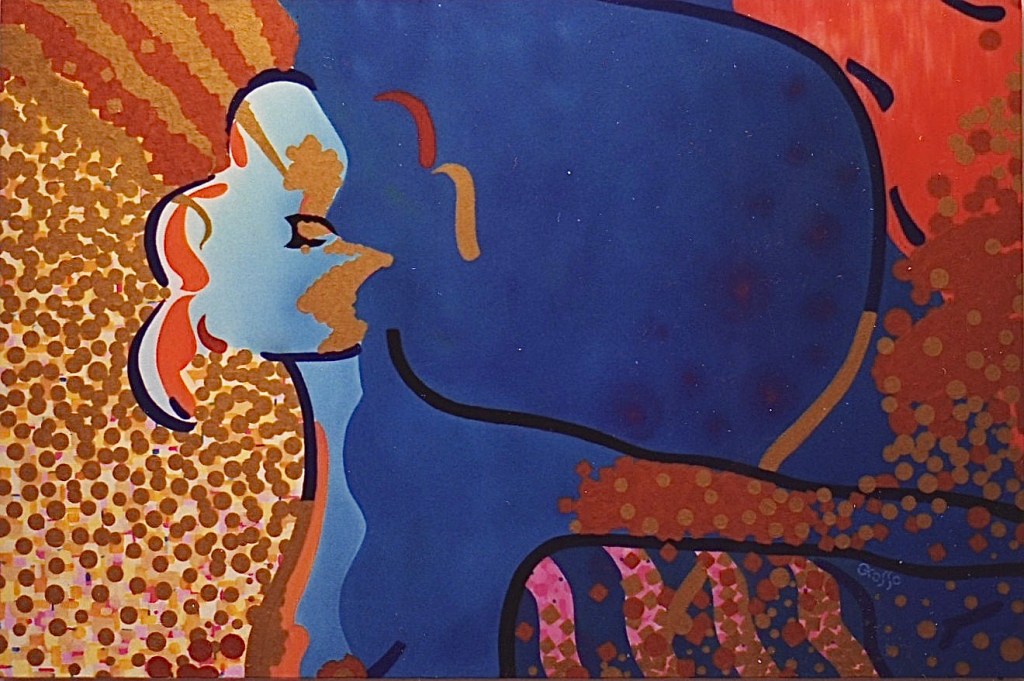
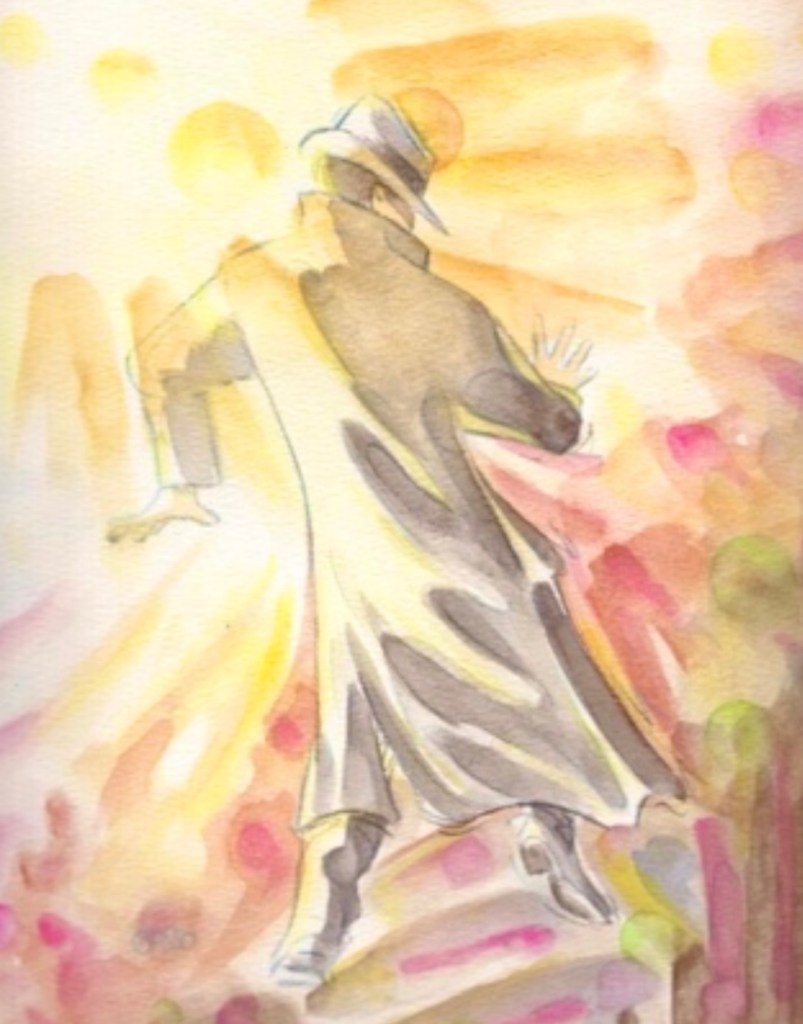
Daytime was disorienting for club kids. You’d see them moving around in the streets to the same rhythms that pushed them around the dance floor the night before. The echo of the club sounds and the general morning grogginess of nighthawks conspired with the eyes to produce strange effects. Like jellyfish below, or angels above, their movements left tactile waves or visible auras; halos perhaps, extrusions from the abject joy overflow. Maybe it’s true that any vista of any crowd would produce something like this to the reddened eye, but it was certainly more evident with club kids, because of the latency of the party, and the muscle memory of musical beat that still governed their limbs. Their bodies had become dedicated to the rhythm, like good spouses, or addicts. It was what moved them physically and emotionally. It was what allowed them to dance three hours straight without a break in a smoky club, and compelled them to go back again, night after night. The clubs were not elite salons. Many were very seedy places where danger held the first table. All were expensive in a time of Reaganomics, where jobs were hard to come by in rust belt cities, where the factories just kept closing. Yet, the outside world seemed to matter little on the dance floor, so they came, poor, bucking danger and ruin, ducking bookies and exes to satisfy the craving for that certain euphoria only found where the music enters your body and you surrender. Better than drugs they’d say; and they were right.
-Danny Grosso

The lights would get so bright on the pulse that for a moment it would look like the dance floor had been transported out of doors, to some English garden party when the late spring flora had exploded with color. Color – that moment of transformation from blue and black to psychedelia, on the pulse of a two-second strobe, was not something he imagined to take from this less than fabulous neighborhood club. The bodies moving within that light, the multi-hued swirling of pegged pants and skirts, cravats and headbands, against a sunbox of light, approximated a Lichtenstein in a centrifuge. Inside of this ordinary brick building with unfinished walls was a living museum of modern art, a prescient multi-media performance piece in a place where few had ever visited an art museum.
We are all artists in our ecstasy, he thought, and then girded himself for the thrill of the next pulse of light.
-Danny Grosso

Excerpt from the story Opening Acts:
…For ten minutes or so they just played around, fumbling really, trying to find a bit of harmony, until Shirley yelled over from the bar: “Why don’t youz find yourselves a song in all that noise.”
“Ok, well, that sounds like a request to me,” Martin said, “follow along with me and give us some lyrics, would ya’ son?”
It was only a few minutes after that when they were chiming like church bells, and Bryan was singing:
And I heard ye now/
come calling to me/
from the abbey ground/
beyond the sea/
and the companion cries/
of the wailing shes/
who’d lost their loves/
in the troubled eighties.
–Danny Grosso