2000 – Presented with a virtual tie and numerous voting irregularities on Election Day, Democratic Presidential Candidate Al Gore overrules some of his advisors and requests a recount of votes cast within the entire State of Florida. The request is for a larger endeavor than the targeted, Broward and Palm Beach County-only recount pushed by members of the Gore team. When the votes are counted, Gore’s strategy is vindicated as he emerges with a narrow victory in Florida, giving him a clear majority in the electoral college, and the presidency.
1/20/01 – Al Gore sworn in as 43rd President of the United States.
9/11/01 – Terrorists attack the United States, flying airplanes into the World Trade Center in New York City, and the Pentagon in Washington D.C. Another plane, believed headed toward the White House, crashes in a Pennsylvania field after passengers disable the hijackers.
2002-2004 – President Gore initiates and executes military operations in Afganistan aimed at finding and bringing to justice those behind the 9/11 attacks. Gore declares that the military operations will be limited in time and destruction, but the human targets prove elusive and the undeclared war drags on much longer than initially expected.
2004 – With the war in Afghanistan dragging on, and accusations of military incompetence beginning to surface in the mainstream media, Republicans nominate war hero and maverick Senator John McCain for President. In a bid for party unity and a nod to the nation’s 41st President, McCain picks Jeb Bush to be his Vice President, saying that the Bush family’s experience in quickly prosecuting, and exiting, the 1991 Gulf War, will inform his presidency. In another extremely close election, McCain wins the State of Florida by a clear majority with the help of his running mate, that State’s sitting Governor, and defeats Gore in the electoral college to become the 44th President. President Gore wins the popular vote, but loses in the electoral college to become the only candidate of the modern era to fail to win the presidency while winning the popular vote.
2005-2007 – President McCain expands military operations in Afganistan and surrounding areas but resists cries from within his own party to expand the war into Iraq and Iran. Still, McCain has more than he bargained for. The hoped-for Gulf alliance proves fleeting and ineffectual. Initial surges in activity by American forces produce desired results, but clear operational victories become harder to define and pursue as opposition networks become more sophisticated and diverse. Surprise operations by the enemy and growing civilian discontent in occupied areas begin to raise the death toll of American soldiers. After 5 years, the American Military effort seems bogged down.
2008 – Democrats nominate Illinois Senator Barack Obama to run against President McCain. Obama, an African-American who spoke consistently and eloquently against the once-popular war, attracts many new voters to the electoral process and thus forges a victory in November.
2009-2011 – President Obama slowly decreases the American military presence in Afganistan. Horrified Republican legislators, who wish to expand the war in accordance with McCain’s initial troop surges, attempt to block Obama’s domestic legislative agenda in protest.
2012 – Republicans nominate former Vice President Jeb Bush to challenge Obama. Bush promises to expand then end the war, a popular sentiment, though by nature, a hedge. Bush leads in many polls through October. However, Obama’s coalition expands due to continuing efforts aimed at registering young voters. That coalition holds and Obama is re-elected.
2013-2015 – Elected Republicans enjoy growing popularity as President Obama continues to have difficulty enacting his domestic agenda. However, grass-roots frustration within the GOP, stemming from losing two seemingly winnable elections, produces much speculation about the party’s next choice of nominee.
2016 – GOP front-runner and former Vice President Jeb Bush faces a tough fight for the nomination against surprise opposition of outsiders trying to change the party…
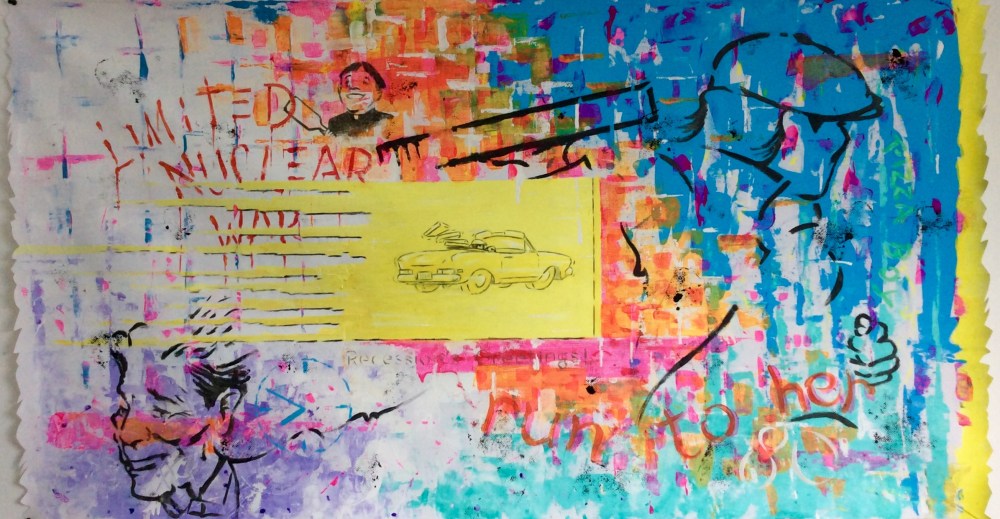
Gimmitted Dookie aw Dewrup – mixed media on cut canvas – copyright Danny Grosso
At the beginning of the presidential campaign, many pols and pundits in the know exuded a confident posture in the face of a large field of Republican candidates. They had a candidate with a resume that was tough to beat. Some said the man was modern history’s best prepared presidential candidate. His experience was relevant and varied, he came from a successful political family, and he appealed to a wide spectrum of primary and general election voters. He was a resume’ candidate. But as the race began, this candidate found his constituency usurped by someone with a gift of gab and a power to stir the apathetic into a political movement that he would captain. He was a personality candidate. Almost before the primary season was underway, the personality candidate seized the news cycle and kept it. The resume’ candidate lost early and often, and was incredulously out of the race soon thereafter.
These were the events of the first few months of 1980. The same story might now be written of the current campaign, and written without changing the surname of one of the candidates.
Prior to the 1980 New Hampshire primary, the flagging campaign of Ronald Reagan helped stage a candidates’ forum, from which Reagan and all candidates not named George H.W. Bush were later disinvited. Reagan showed up anyway, having assisted in funding the forum, and was greeted with knowing grins from the moderator and from Bush and his team. Bush was an insider’s favorite, a former congressman, CIA Director, Ambassador to China, and RNC Chairman. His father had been a well-respected moderate senator from Connecticut. His international business and political connections meant that the line of establishment support for his candidacy stretched around the globe. He was seated at the speakers table, seemingly lying in wait. Perhaps he knew what the moderators had in store. Reagan entered the event, pale and stark looking, all dark suit and slick hair on a New England winter evening. When he took the microphone to speak, the moderators asked him to stop. Bush did nothing. When Regan began speaking, the moderators asked that the candidate’s microphone be turned off. Bush did nothing. Other disinvited candidates gathered behind Reagan. Something changed in the room. Now, loudly and with fury, Reagan grabbed the mic, turned to the moderators and said “I am paying for this microphone!” The crowd cheered. Bush sank in his chair, but otherwise did… nothing. The race was effectively over shortly thereafter.
Reagan, the old movie actor, had stolen the scene, and with it any passion that voters had for Bush, and done it so quickly that the rest of the Bush campaign was spent wondering how it all happened.
Fast forward to 2016, and the parallels astound. Prior to the election season, Jeb Bush was the darling of the establishment and favorite to win the GOP nomination. Nice resume’. Donald Trump was best known as a wealthy businessman and reality TV star. Famous personality. Trump announced his candidacy the day after Jeb Bush did and immediately seized the news cycle with provocative comments. Jeb dismissed him entirely. Couple that with Trump’s immediate and unanswered onslaught of rhetoric meant to diminish Bush’s standing, popularity, and even manhood (he called him “low energy” and “weak” from the get go) and you can merge the images of Jeb and his father, George H.W., stooped shoulders and palms to heaven, without being able to tell the difference between them. Both Bushes made late attempts to argue policy, (Jeb was caught on video pleading with an audience to applaud his wonkish campaign speech), but were soon drowned out by popular chanting – remember: “U.S.A. – U.S.A.!” from the “Miracle on Ice” U.S. Olympic hockey team, a chant that was also heard at Regan rallies and is now a set piece at Trump events. Adding to the dissonance was popular sloganeering – Reagan: “America is Reagan Country”, and “America is a Shining City”. Trump: “Let’s make America Great Again”.
In the end, both Bushes found it impossible to heard on policy issues, and to defeat the soon accepted notions about the superiority of their opponents’ personalities – that these men, both outsiders to the establishment, were genuine American originals, destined to head movements away from established norms, away from established candidates. Get on board, folks, we’re the newest, biggest thing in politics.
It didn’t matter that both personality candidates lacked the tried and true pedigrees of GOP nominees and were themselves constructs of political opportunity. The Bushes lost the races in 1980 and 2016 before most of the country knew how the victors would govern. Jeb and his father were victims of their own passivity, conservative deportment, and of the changing times, though the Bushes, well liked as they both are and still stinging over being rebuked by their own in favor of outsiders, might call it separate instances of personality crime.
The current political campaign may seem to be overstaying its welcome, a Franklin fish past its three days, but we’ve a long way to go yet. Our four-year cycle uses up fully half that time in full-blown battle mode, and the rest of it in clandestine cajoling and fundraising among nascent super pacs. The long run to office is long bemoaned. Many have wishes to change the system to a more truncated, less expensive one, modeled on European elections. Campaigns over there are limited by the amounts and origins of money spent, and usually confined, as in the U.K., for instance, to publicly (and modestly) financed affairs of around six months in duration.
The removal of money as influence from politics, generally, has wide support and that is justly so. Even incremental changes in that direction would do wonders for American voters worried about the influence special interests might buy. Large contributions to politicians in need of cash to finance their candidacies leaves little room but for suspicion. The recent surges of the Trump and Sanders campaigns show how tolerance has lessened for candidates that are perceived as owing favors to corporate and institutional contributors. The disdain for this part of our system is decades old and shows no sign of ebbing.
The prospect of shorter campaigns, however, is one where voters’ attitudes might have evolved. This country is so big, so diverse and complex, and so wrought with responsibilities to its citizens and to the world, that candidates for its top offices are given second, third, and forth vetting by its voters. Through living room teas, and town hall meetings, through candidate forums and partisan debates, through caucuses and primaries, conventions, and nominee’s debates, countless questions are answered about the several men and women vying for a single office. This is, and needs to be, a particularly American sequence of events. The enormity of the American presidency means that the voters should be given every opportunity to get a long look at the candidates for that office.
The media age provides easy video access to even mundane political events. However, the voters’ ability to glean information about candidates is muted by the candidates’ knowledge of that ability. The modern, scripted candidate is built to withhold information, stay on message, defy the media accessibility that voters once thought would be a key to informed choices. Under the regime of the political handlers, more access often means less real information.
Because of the tension between the withholders of information and those who wish to be informed, the long run of American political campaigns has become a function unto itself. The extended period of exposure to media coverage and voter scrutiny is now the best tool the populace has against the tendency among the national campaigns to obfuscate or outright lie. Even without taking an investigative stance toward the candidates, a voter given time to think might change his or her mind, find a better fit, and do so before it is too late. To this end, it should be remembered that if elections were shorter affairs, Ed Muskie, John Connally, Rudi Guiliani, and Scott Walker might have reached the office they coveted. All of these candidates’ hopes faded as voters, over time, moved on to another. Without long campaigns, busy Americans might be forced to settle for their first suitors.
In 2008, Sarah Palin’s campaign staff wondered if their candidate was intellectually and emotionally prepared to be Vice President, and took great lengths to hide the truth of Palin’s limitations from the country. The long run of that campaign created space within which the truth could be searched for and exposed to public scrutiny. Without making judgments as to the fault for Palin’s limitations, it is clear that they predated her elevation, and that they were exposed simply because the voters had the time to see them.
So settle in, we haven’t even gotten to Super Tuesday yet…




 art is politics is art - Civil Discourse Matters