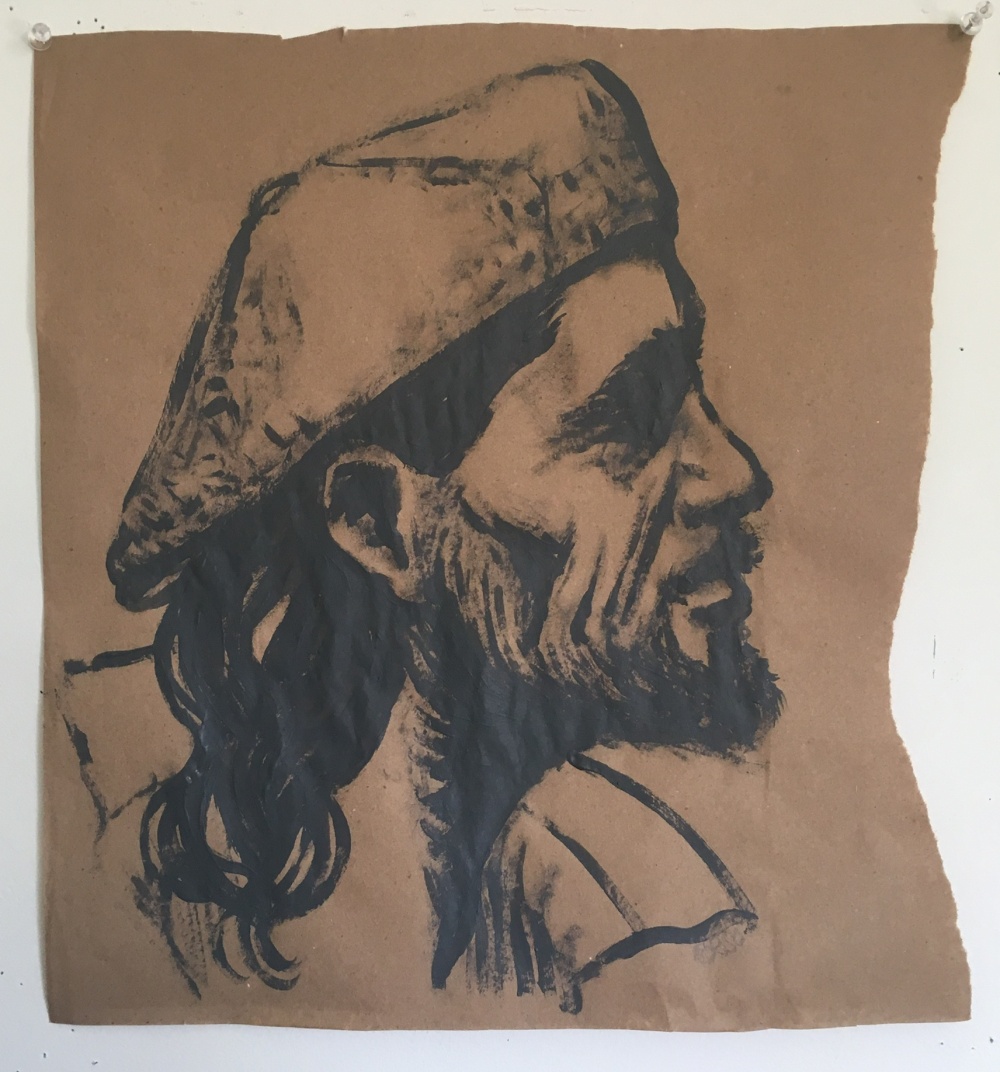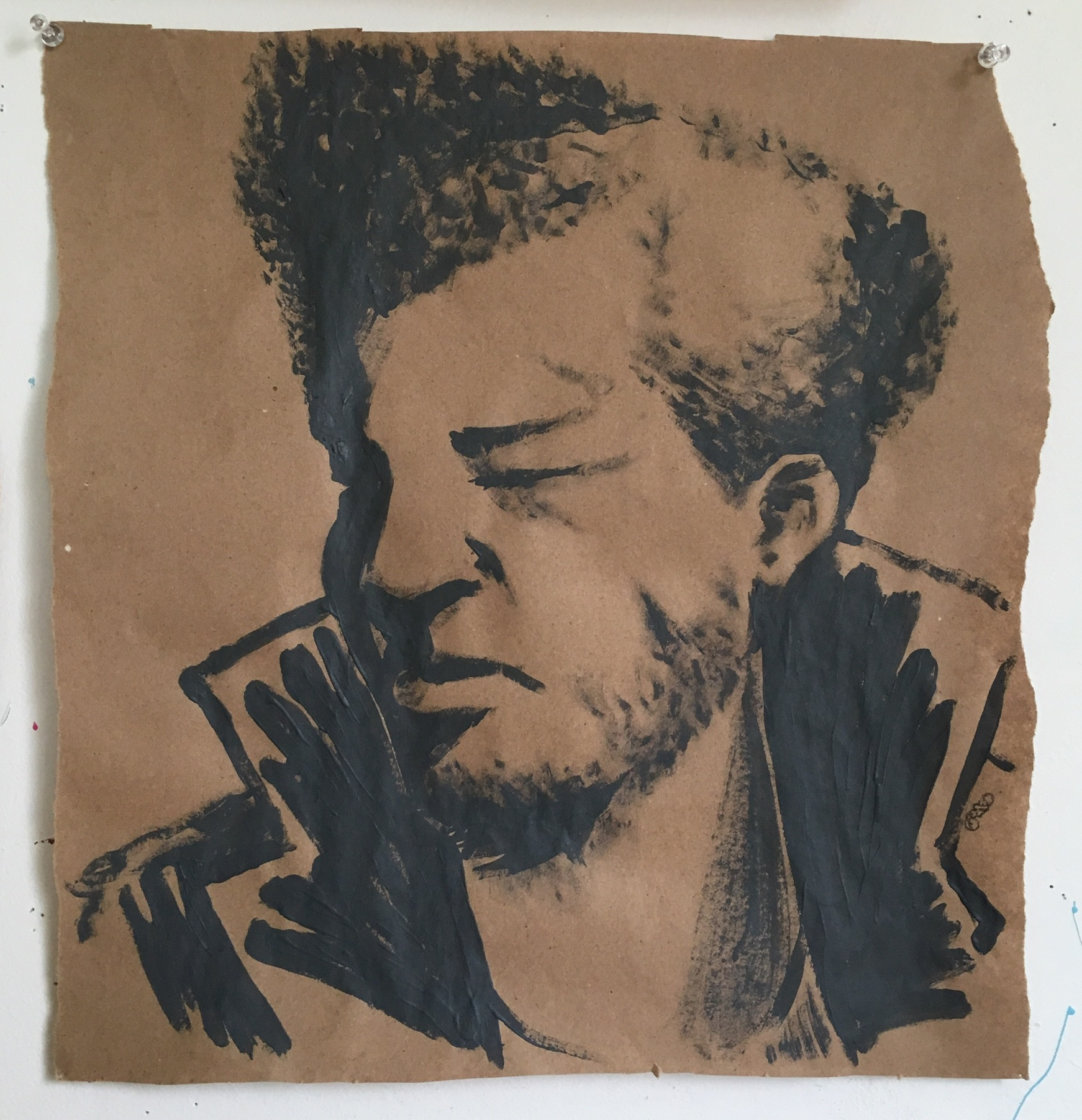
Mud People, No. 21 – He Chased Pretty Girls (2019). House paint mixed with mud, on paper. From my book 37 Mud People, available at Amazon Books. Artwork and text copyright Danny Grosso.
“Long ago, long ago” he said, or rather muttered, to himself over and over, all day. To see him now was a sad vignette, a tragedy within a tragedy, a moment within a life.
Once he was tall and straight, with a Clark Gable mustache and an eye to the future, but now…
Living in the past is not really what it is, more like living in moment, past and future unimaginable, in a room with a window but no door.
Sometimes he went outside, on his bicycle, to scrounge around for things you can find when your head is down. The averted gazes of others left a wider space for him to operate, though operating often just meant looking for discarded butts. He knew that he knew many of these people, and that he was not entirely unrecognizable under the beard. He also knew they wouldn’t confront him. He’d burned enough emotional bridges to insure his relative isolation, and the hat and beard did the rest.
Long ago he didn’t have to hide. He wore loud clothes in the club, he dropped names, he chased pretty girls. The quiet confidence of that age is gone, another tragedy within a tragedy.
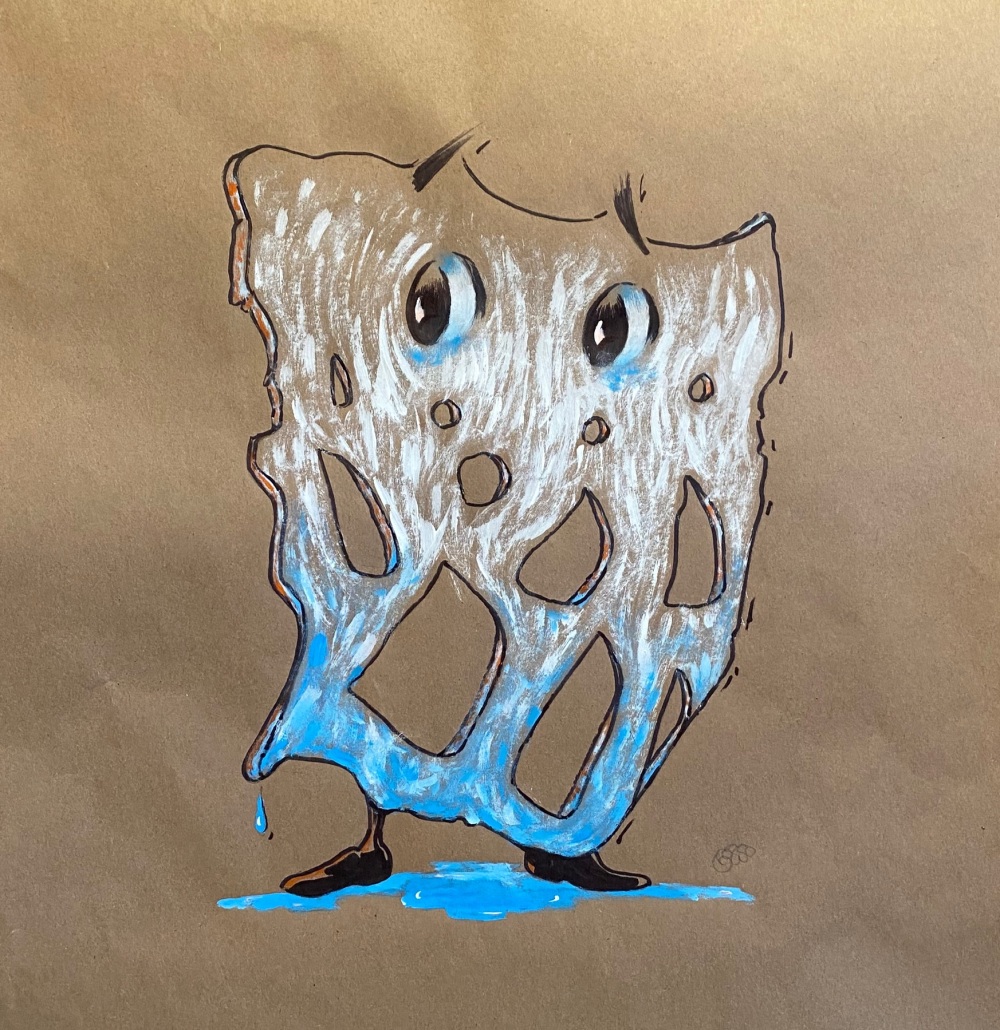
The Leaker (2020). Acrylic and ink on paper. Artwork and text copyright Danny Grosso.
Continuing the expeditions of Jeff MacNelly, James Kilpatrick, and Eugene McCarthy, with apologies.
The Leaker
The Leaker just can’t help it, so it seems. Bequeathed with a mind full of valuable, extraneous information, set upon by a ravenous pack of info hounds, the Leaker does what it must: it leaks. Sponge-like and cheese-holed, its life cycle is the rhythmic taking on of information and subsequent discharge of same, all to a fetishized following of pilot-fishing scribblers whose living depends on this arrangement. Bigger beasts attempting to interrupt the Leaker’s cycle have been vexed through the ages – the leaker is of a perfect, if to some, somewhat nefarious design. Regardless of sanction, reassignment, book advance, or exclusive interview with pre-approved lines of inquiry, it does what it is designed to do, and the drip, drip of info feeds the greater ecosphere around it. In this way the Leaker may be one of the most generous and essential creatures in the bestiary. It gives out as much as it takes in, often to the accrual of beneficiaries far-flung and unaware.
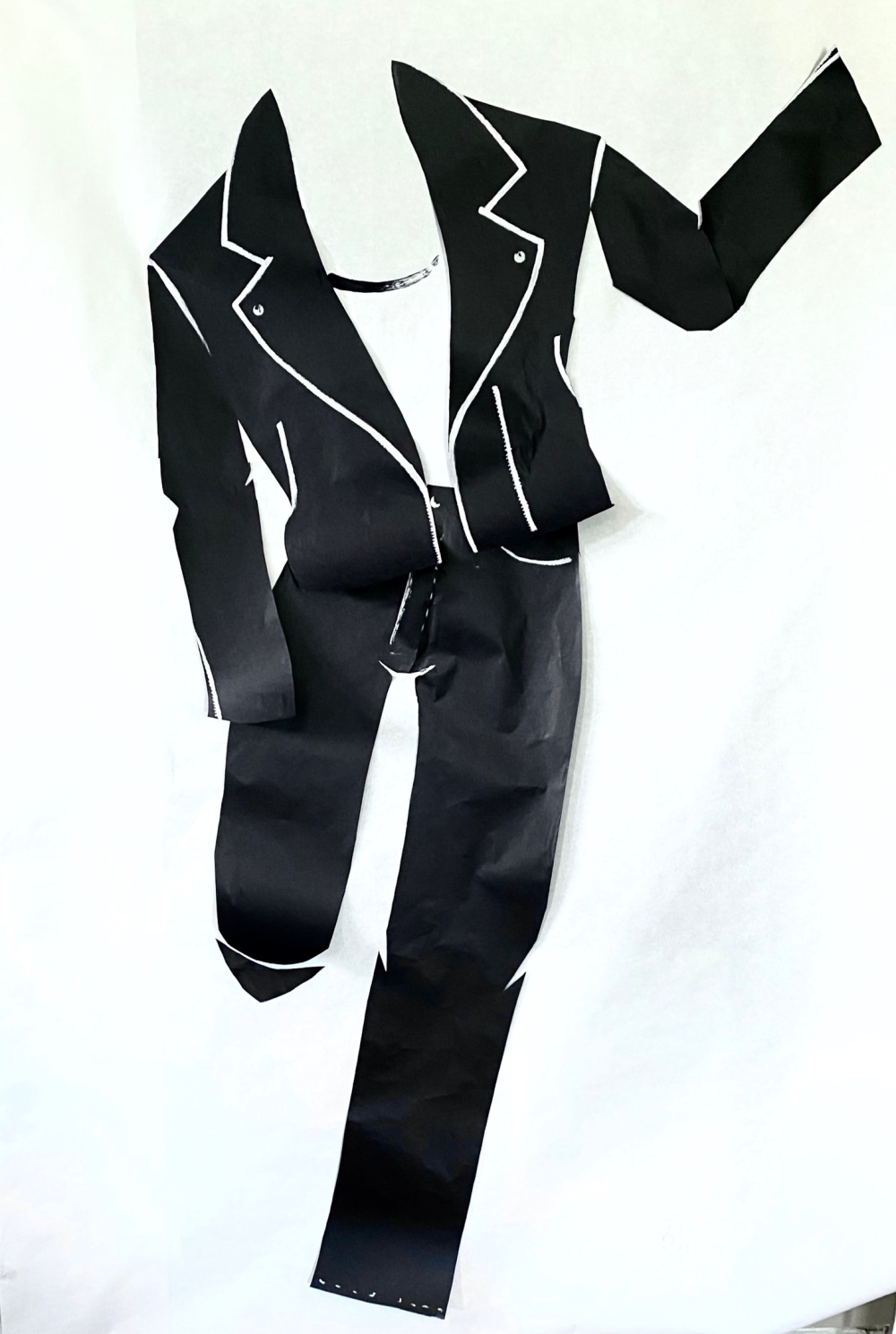
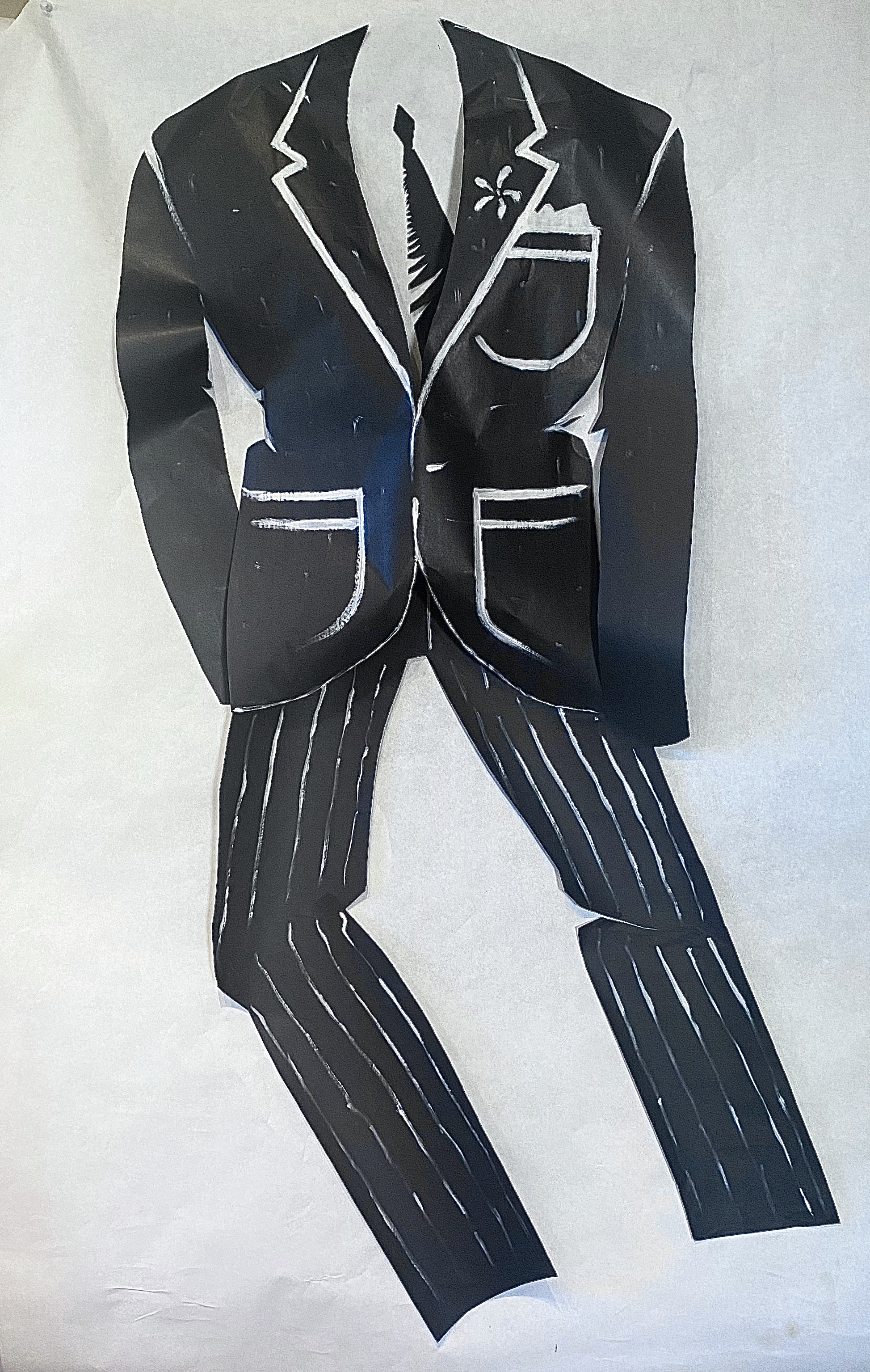
Leather Denim Formal (2020). Acrylic on cut paper. From the book Barefoot and Other Stories, available at Amazon Books. Artwork and text copyright Danny Grosso.
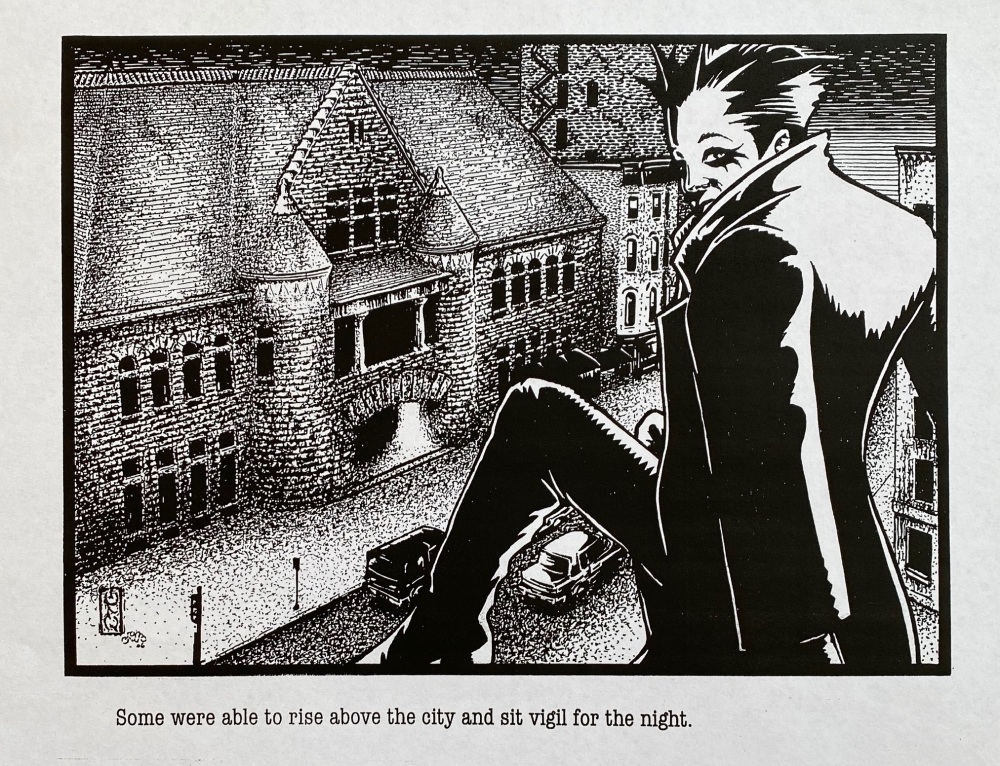
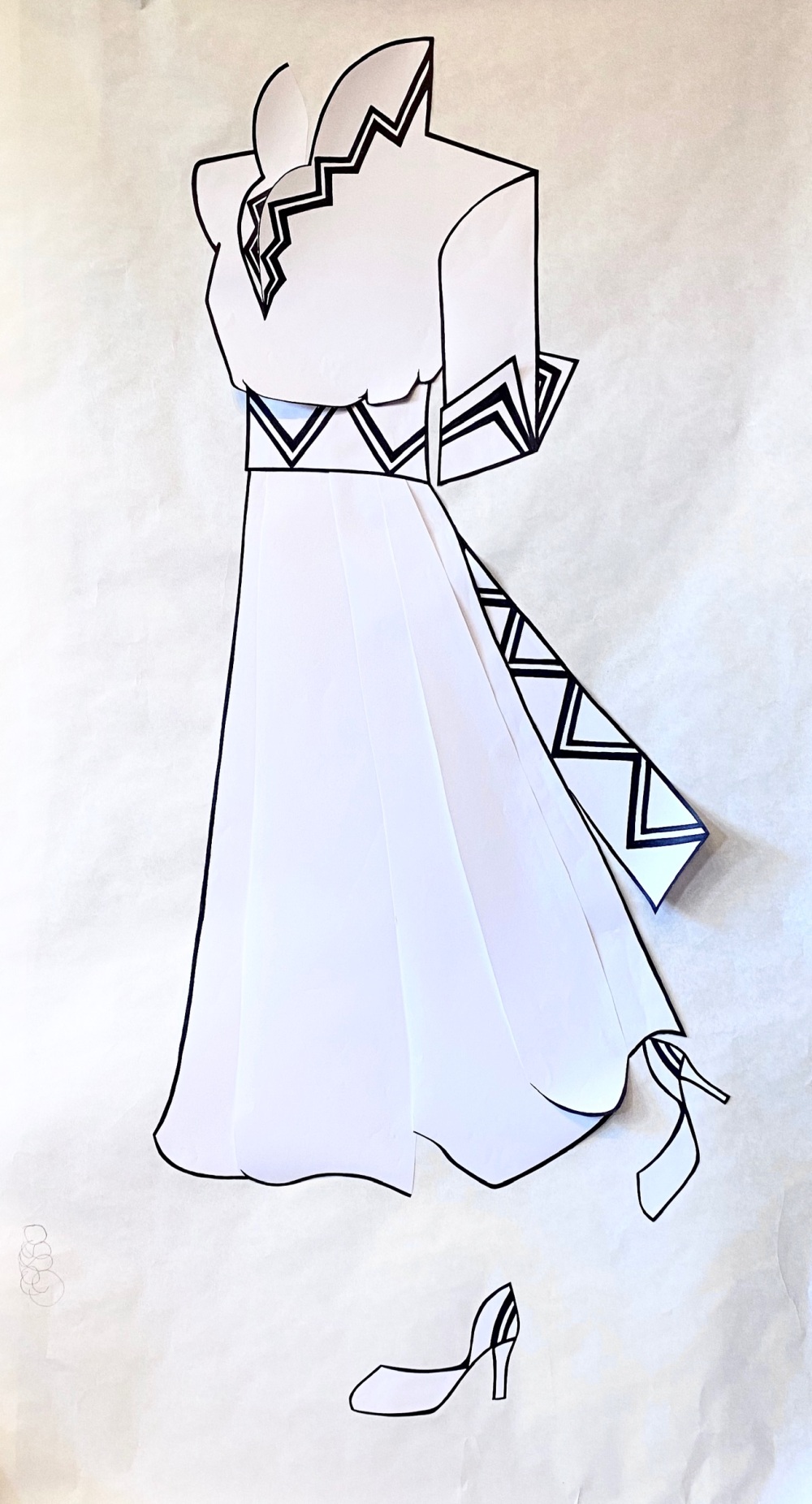
On Walton Place (2022). Acrylic on Wood. Artwork and text copyright Danny Grosso. From the book The Rosebud Vignettes available at Amazon Books.
The party started early and ended late. Some people are made to be together – though often not in groups as big as this. Like some dusty love song, this crew could not quit each other, regulars on Walton Place, as integral as the kitchen. By 5:30 on Fridays they were over-populating the bar, pushing the conventioneers to the side tables. They ate a bit, drank a bit more, and laughed – my, did they laugh. The uproar made it good to be back out, among people again, and provided a bit of vindication to those whose trust in humanity had not cratered during the crisis. Stepping back from it now, it seems like their lives overlapped into one another, in the ethereal synergies of friendships, and physically, in their manner and dress. A contour drawing of one continuous line, eliciting eye and cheek, hairline and lapel. Friends are friends, one hopes, praying they don’t become something else. After even short periods of solemn absence, the noise of affection summons like a gathering bell, leading some to find their better places among other’s hearts.
Mud People, No. 20 (2019). House paint mixed with mud, on paper. From the book 37 Mud People, available at Amazon Books. Artwork and text copyright Danny Grosso.
Looking around is hard when your eyes are closed, but he muddled through the day anyway. The slits that let in the sights would open up at some point in the day when he wasn’t high, and for that short period before he lit up again the garish world around him was frightening. Too bright, too fast, too loud, man. Still, he liked to walk about everyday, as if taking the bitter to better love the sweet, and each block he passed made him yearn more for the incense of his apartment. He’d learned to wear a jacket above his sleeveless, in case he wandered too far, or ran into another partier, and didn’t turn around toward home until after the cold of night set in. Leather. Big inside pockets to hide your stash. The older guys taught him that when he was just a kid – that and a few other things, like opening the door for the ladies, splitting what’s on you in two so you might keep one package if you get rousted.
He bumped into a street lamp. No problem. The slow burnout gait made obstructions less painful. He heard a giggle. No problem. He heard giggling in his head all day. What was the difference if someone else was laughing? Let them join in. He was a happy person and to stay that way he knew others had to be happy too. Giggle away, people and laugh out loud, I may be the object of your mirth but I don’t care because I can’t see you. You are just a bunch of happy sounds to me, the way the world should be. A bunch of happy sounds.
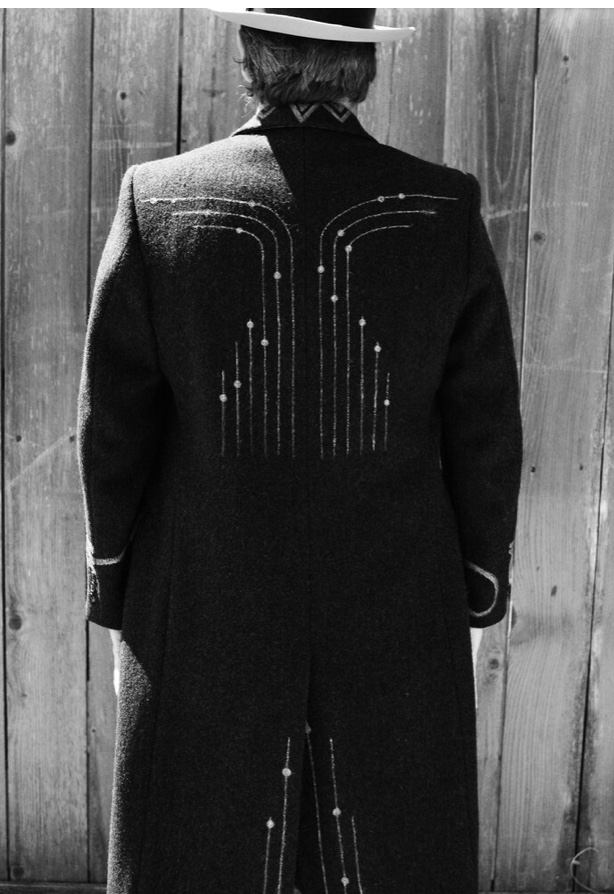
Deco Love (2019). Fabric paint on wool coat. Artwork and text copyright Danny Grosso.
Time was when he was everywhere. Everyone knew Deco Love. Sliding into a jazz club, or shuffling past a beat cop, he’d flash a grin and a wink and leave you with a smile on your own mug. Some said he was a pusher, or a bootlegger, maybe a pimp, but no one ever saw him plying such trades. Maybe he just looked right for those parts, with his long custom dusters and his wide brimmed lids; and that walk, with the little hitch that seemed in sync with every basement playing band he passed on the avenue.
At night he’d arrive with a lady and leave alone, only to show up later at another club, with another lady. He’d drink with the heavies – the club owners who were connected with the powers on both sides, and after-party with the bands after three or four sets amid the sinewy smoke. Some said he played the ivories, and would sit in once in awhile when the joints closed up, with a coronet player or skin banger that needed tuning up. There were tap dancers around who said he’d frequent their hoofers’ clubs, learning musical hooks, rhythms that he’d weave into his speech patterns; Lady, Lady Love-el-lee Lady…
At night, his long coats would hide every bit of him but his shoes, and they were enough of a sight on their own. He had this thing where he’d kick up a heel at a corner, like a sprinter in a block, then skip off with a little t-Tap against the asphalt, It would send him gliding off, coat tails in the air ever so slightly, so gracefully, vibing to some song bouncing around in his mind.
The echoes of the life we lead are with us while we are here and with others after we are gone.
-Danny Grosso
For more, follow on Instagram @artipolitics and @altoegovintage
Christmas Eve (1980-?). Acrylic on cardboard. Artwork and text copyright Danny Grosso.
Back then, when the tree sellers closed their businesses for the season on Christmas Eve, they would abandon their unsold inventory on the otherwise vacant lots. The hawkers of balsam and fir had no use for their wares after December 24, so the trees stood alone in the dark, like pilgrims queuing up for a shrine. In our neighborhood, late at night on that twinkling holiday, a liberator would appear, dancing through the snowy and quieted lots. The legend has it that he would take the forsaken tannenbaums, throw them into the back of his drop-top sled, and deliver them to shut-ins, leaving the evergreens on front porches for Christmas morning discoveries. The recipients were easily chosen, for in that era, most neighbors commiserated with one another, and one might easily determine which of them were unable, due to illness, poverty, or other misfortune, to venture out and deck the halls.
This was much spoken about for some time, and the mystery surrounding the identity of the benevolent phantom was never convincingly solved. Over time, as often happens, people turned to speculating about other, newly discovered intrigues, and interest in the phantom waned. Yet, even now, we are greeted each winter, in one or two pieces of holiday correspondence from the old neighborhood, with news of Christmas trees being left anonymously on porches.
All legends die hard, especially those grounded in the time of willing hearts and kind intentions.
Barefoot (2020). Acrylic on cut paper. From the book Barefoot and Other Stories. Available at Amazon Books. Artwork and text copyright Danny Grosso.
When the tailor came out for the first fitting, the customer was sometimes barefoot. In summertime, as the 70’s fell out into the 80’s. men would wear light-colored loafers, without socks, as they went about on Saturdays. If they stopped into a clothier on a whim, and were cajoled into a purchase, they’d sometimes emerge from the fitting room barefoot, as if tailoring a trouser leg was too formal an event for loafers. Barefoot, however; somehow more appropriate.
The tailor, responding to a salesman’s buzzer signal discretely triggered from behind a mirror, would stride out as if to martial music, and slow the march upon the sight of toes wiggling under the un-hemmed pant legs. With a grunt, he’d point to the offending nakedness, and the salesman would be compelled to inquire of the gentleman as to what kind of heel he might be wearing with the ensemble. Now, the 70’s had passed and taken platform shoes with them. So, the tailor could, in expert approximation of median heel height, tailor a pair of paints for a barefoot customer. However, this entire vignette was yet another unspoken signal to the salesman to skip over to the shoe department and bring a pair back that might ease the tailoring process and wrap up another sale.
Salesmen quickly learned to approximate a customer’s suit size upon first sight. Shoe size, though? Much more difficult. Further complicating matters, one couldn’t propose the purchase of an ill-fitting, pinching shoe. Nor would one wish to keep a busy tailor waiting as a customer tried to wedge his foot into a too-small monk. The result was that all of the size 11 and 12 shoes were stacked on top of the piled shoebox displays for easy gathering. The customer could slide right in, and if the salesman chose right, and the customer liked the way the shoe looked with the suit, he could fit the pair after the tailor had left the sales floor. If this little bit of theater resulted in extra commission for the salesman, the tailor would get his lunch for free that day.
One might surmise that all of this salescraft and subterfuge soured everyone to the whole enterprise of visiting the haberdasher, but for all that was shadowplay, there was a real elegance to the ritual. Some regulars were rich dandies but many of the customers visited rarely, only in special times of celebration or need. A wedding suit or tux, or maybe one to wear to a son’s graduation – something very nice because he’s the first in the family to go to college. Standing in that grand three-way mirror for a fitting prefigured the pomp and circumstance of matrimony or commencement, and added an extra day of harmless indulgence to the event. The sales staff kept a bottle of single malt and shot glasses in the stockroom to share with customers like these.
Of course, the most dignified presentation was reserved for the mourning. The store would hush as word went about. “Funeral suits” one would say to a colleague, nodding toward the aggrieved. The respect afforded to these poor souls was edifying. Salesman who spoke out of the corners of the mouths to neighborhood hoodlums stopped dropping the endings of words. They stood upright, addressed the family as “Sir” and “Madam”, and guaranteed the garments would be fitted and delivered for them to wear in time for them to receive the line at the visitation. Tailors would pay their verbal respects in broken English and then stay late if the alterations for these customers were complex. The staff, arriving early the next morning, would sometimes place notes of condolence in the pockets of the finished garments.
There were times when a mourner, retrieving his mourning garment, confessed that he knew not how to tie a cravat. A stockboy would ask for the tie, discreetly slide into the stockroom, and emerge with it knotted and dimpled; ready for a simple donning.
“Thank you.” the relieved mourner would say, quietly.
These small, elegant moments are mostly gone now, perished with the advent of the digital economy, the casual Friday, and the triumph of the big box store.