Unpatrolled

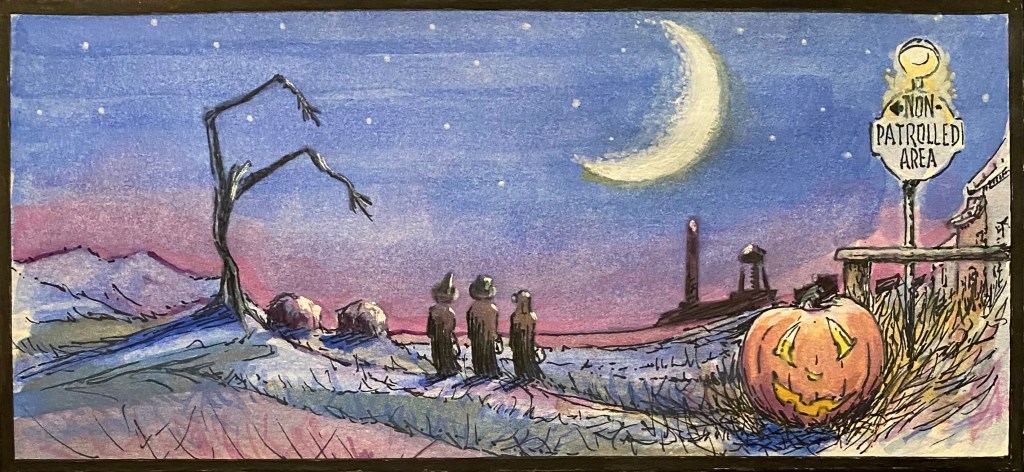
Non-patrolled Area (2023). Watercolor on paper. From my book, Holograms and Long Tweeds, available on Amazon Books.

Excerpt: The kids went out there anyway. How could they not? The warning signs were like invites, gilded and promising all a pleasant diversion. Under the yellow lights, the words “Non-Patrolled Area” were an official designation for badlands, lawless prairie, go at your own risk. Signs were placed to remind the locals that the authorities did not venture into the void unless summoned in an emergency. There were not enough peace officers to cast a wide web, and besides, the town had never incorporated the empty spaces beside it. The hamlet was close to the openness of the undeveloped side of the county, and for years the places outside of town were frolicked in daylight, shunned in darkness. That said, rogues and mischievous teenagers gathered out there at night, and on Halloween kids would run through the long grasses looking for goblins. This was all before the real trouble began.

Sometimes you can hear things coming, but this all started with a silent flash of light. The sound came later, a strange hum, like an old green fridge on a crooked floor and it seemed incessant until it suddenly stopped for moment, and then started up again. The sound is was brought authorities, and others, to the unpatrolled area – at first nobody believed those who were out at night looking west at nothing who then reported the flash.

The authorities and many other sleuths, including amateurs from the town, blanketed the area with searches, moving way, way out; in time, almost to the end of the county, 7 miles away, in search of the producer of the sound. Their searches provided no clues. The sound never got louder, or more muted, never peaked or fell in pitch, and never modulated. It was all around, enveloping, and its locus was untraceable. Returning searchers reported finding nothing, and seemed unchanged until a local doctor noted strange elongations in the fingers of some of the scouts. There seemed no other physiological changes in any of the subjects, and as the years passed without any pestilence or psychosis attributed to the sound, the town got used to the strange mutation. The Doc called it piano finger syndrome, because of the sound, and the newfound ability of the deformed to play the notes of two octaves with one hand. Town elders held a meeting to decide whether to inform outside authorities, the army, the federal civil service, of the relevant events. After a little discussion, it was decided that the townspeople did not want to be exposed as freaks, or invalids, or even non-conformists, any of which might turn the town into one big circus tent, and invite outsiders to venture in to humiliate the innocents affected. It was also decided that the physiological anomaly would be ignored by the townspeople and the elongation of fingers would forevermore be treated as the normal and proper proportion of digital extremity. The townspeople, relieved that they would not become media curiosities, agreed to the stricture.

A generation has passed since those events. The signs are still posted on the edge of town. The sound is still everywhere. There is more music emanating from parlor windows now, as the townspeople are especially proficient jazz pianists. The mystery of it all abides, and sometimes chills those that think too much about it. Life is about accepting new normalities. Halloween brings scary stories and horror films to a town with an unknown force teeming at its edge. The day also finds young people frolicking, in costume, all over the unpatrolled area.

There is ample to be afraid of in their modern world, and yet the kids still go out there. How could they not?

–Danny Grosso

My Amazon author’s page: amazon.com/author/dannygrosso

Instagram @artispolitics

Artwork and text copyright Danny Grosso
And More Sci-Fi Adventures

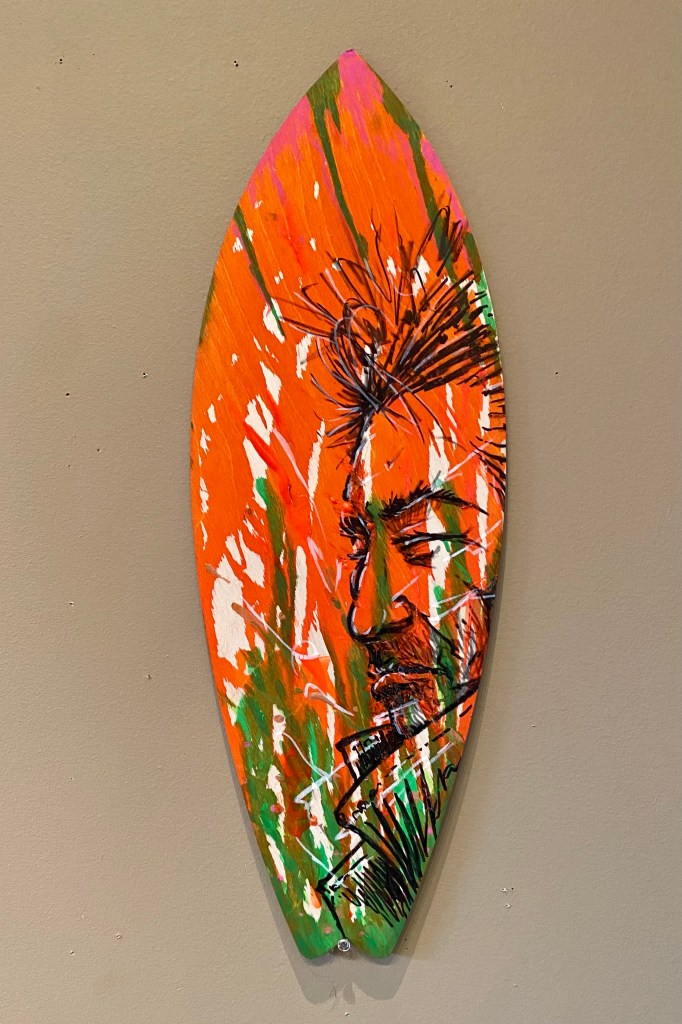
Koni (2022). Acrylic on wood. From my book, Holograms and Long Tweeds, available at Amazon Books. Artwork and text copyright Danny Grosso.

Excerpt: Blink. That’s what the light did, blink, the one that was supposed to remain steady. Also, it was red, not green, which meant that this alternate powered vehicle was not starting up again any time soon.

They called this the neon district, because a century and a half ago it had gas-illuminated tubes announcing the identities of shopkeepers. Now the lights were new energy, and blanketed the night streets with color. As he exited the vehicle, the pallor changed from violet to orange. The chip in his hand had signaled is favorite color. The mist in the air from the passing showers gave the district some extra humidity, and the cafeteria to his left seeped its cold moisture onto the window panes. It had been doing so for a while, it seemed – some of the sludge had greened.

He crept out slowly. Modern vehicles didn’t give out meekly, and this could be a trap. His reinforced collar was up to protect against a neck attack. and he had some jacket plates, but he knew how many vulnerable targets he presented on his person, especially to some of the new micro weaponry. At least he wouldn’t feel it – they say the jab was so small, the victims are unaware of the wounding.

Around him swam the iridescent babyflies and vapor gauzes, products of climate-driven rapid evolution. His grandfather, negotiating these same streets, would never have known these beings. He’d turned and scanned enough now, and stepping forward, he heard a crash. From his quick-held crouch, he saw that the noise was one the old man might have recognized. And old metal can crashing onto the pavement. Most of those receptacles had been long ago confiscated for upselling. He rose and stepped out, into the wet, into the steam, into the colored lights that went tangerine as he passed.

So much had changed since the old man’s days here, yet, like the geezer, he still carried a hand-held weapon. He grabbed it from its holster at the small of his back, and ducked into a dark alley. At the end of it was a door the color of a verdant meadow, like the natural spaces that once thrived outside of the city. It was lit by a single light cell, so that the base of the door was obscured, but he could make out a figure laying low on the landing. Now his weapon pulled him along. Making his way forward against a black painted wall, stepping and re-setting, one foot forward and then the other pulled even, he made a slow approach. Perhaps a bit too slow.

When he reached the doorway, the figure had disappeared, as often happened in this time of disappearances, holographic, and otherwise. He only hoped that the men that now appeared in the darkness behind him would have the same unsatisfactory visual experience.

–Danny Grosso

Excerpted from my story, Blink, from my book, Holograms and Long Tweeds.

My Amazon author’s page: amazon.com/author/dannygrosso

Instagram @artispolitics

Book News

Now available at Amazon Books. Holograms and Long Tweeds. Sci-fi, alternate histories, and thrillers derived from and including my paintings. This collection is a departure from my previous releases, and the stories and pictures may transport the reader to places on earth and elsewhere that lie beyond quotidian concerns. Among the plot lines of these eleven stories: a Halloween tradition evolves from a troubling mystery; a 22nd century cop encounters his father’s legacy in a rain-drenched city; a nascent technology allows two lovers to float above Paris; acts of treachery delay the reckonings of the American Civil War. Filled with poignant painted images, this book holds strong appeal for both the reader and the art lover.

Order a copy!

My Amazon author’s page: amazon.com/author/dannygrosso

Instagram @artispolitics